

Every company registered in Ohio collects a file with the Secretary of State, and that file grows one accepted document at a time. Articles, amendments, agent appointments, reports, and name changes all land in it with a document number and a date. The public sees the list and can order copies of most items, which makes the file a usable history rather than a single snapshot.
This page describes what the file holds, what each kind of paper establishes, and how older material is arranged. It covers formation documents, amendments, the April report, agent updates, trade names, the records the office does not keep, ordering copies, and retention. Charges appear in one table near the end, and no figure is quoted in the running text.
What the File Holds
The Ohio Business Records lookup on this site displays the same list the Secretary of State keeps for each entity, with dates and document numbers attached. The list opens with the formation document and, in most cases, ends with a dissolution or a cancellation. Between those two points sit the papers a company filed to stay current and to record changes.
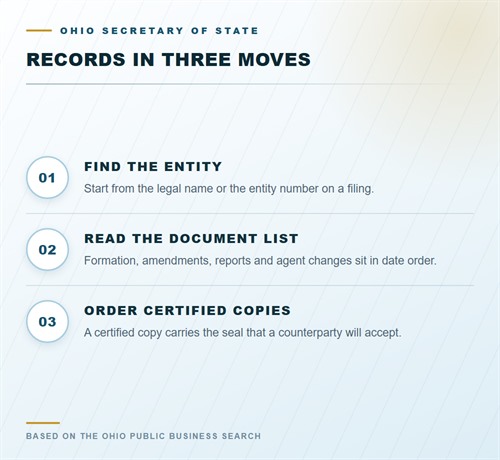
Ohio Secretary of State, Business Services Division, filing history for any registered entity:
https://businesssearch.ohiosos.gov/
Formation Documents
For a domestic LLC the first paper is the articles of organization. For a corporation it is the articles of incorporation, which also produce a charter number alongside the entity number. A company formed elsewhere enters the register through an application for registration instead. Each of these documents fixes the name, the effective date, and the statutory agent at the start.
Articles of Organization
The form asks for a company name that ends with a permitted designator, a principal office, an agent with an Ohio street address, and a signature. It also states whether the company is member-managed or manager-managed. Once accepted, the articles become the document a bank or a title company asks to see in certified form.
Articles of Incorporation
A corporation files articles that name its incorporators, its share structure, and its agent. The office assigns an entity number and a charter number, and both appear on later filings. The charter number descends from the older practice of chartering companies by act, and it still identifies the corporation in some correspondence. A reader holding either number can find the file.
Application for Registration
A foreign company files an application that names its home jurisdiction, its home entity number, and an Ohio agent who has accepted the appointment in writing. The Ohio file does not hold the out-of-state formation papers, so a reader who needs those asks the company or its home registry. The application itself proves only the authority to do business here.
The Effective Date
The effective date on the articles can be later than the day the office accepts them, if the organizer asks for a delayed start. A reader comparing a contract with the file should use the effective date rather than the stamp date, because authority begins when the document says it does. Both dates appear in the history.
Amendments and Restated Filings
Companies change. An amendment records a new name, a new purpose, a new share count, or a revised agent provision. Each accepted amendment joins the list in date order, and the detail page shows the current facts while the history shows what came before. A reader who needs to know when a change took effect reads the accepted date rather than the signature date.
Changes by Amendment
A single amendment can carry one change or several, and the office records it as one document with one date. A reader who wants to know when a particular clause changed may need to open more than one filing, because a later amendment can alter a provision that an earlier one set. The sequence, not any single paper, tells the story.
Restated Articles
A restatement replaces the whole of the formation document rather than altering one clause. It is useful when the original has been amended several times and nobody wants to read the chain. The restated version appears as its own filing, and the earlier documents stay in the history for anyone tracing the order of events.
What an Amendment Cannot Do
It cannot erase the earlier filing. The record keeps the superseded text, which matters in a dispute over what a company was authorized to do at a past date. A contract signed under an older purpose clause is read against the document in force at signing, not against the version on file today, and the older text stays readable in the chain.
Preclearance Before Submission
An organizer who wants a filing checked before it is sent can buy a preclearance review. The office reads the draft and points out defects, which shortens the wait after submission. The review covers form and procedure rather than the wisdom of the transaction, and it neither reserves the name nor accepts the document. A draft that passes the review is usually accepted on the first submission.
Annual Reports in the History
An LLC and a corporation each file an annual report by April 1, and the office charges nothing for it. The report restates the principal office, the agent, and a contact address. In the history it works as a yearly marker, showing that the company was reachable and organized on that date. A missing year stands out beside the others.
The Report as a Date Marker
Reports appear in sequence, and a gap in that sequence is easy to see. A reader checking whether a company kept up can compare the most recent report with the current year. The report restates no owners and no finances, so it proves compliance with one requirement rather than general health. Counting the entries takes a moment and says a good deal.
A Late Report
A late report can still be filed, and a record that stays out of compliance may draw action from the office. The history then shows the late filing and whatever status change followed it. Clearing the record can require the missed reports as well as the charges attached to them, and the sequence of those filings matters.
Reports and the Company Address
The report restates a contact address, which can differ from the principal office and from the agent’s address. Mail sent there reaches the company rather than the office, and a notice that goes unanswered can still lead to action on the record. A stale entry is worth flagging during a review, because mail goes astray long before anyone raises the subject.
Statutory Agent Filings
The statutory agent accepts service of process and official mail, and the appointment includes a written acceptance filed with the office. A change of agent, a change of the agent’s address, and a resignation each produce their own entry in the history. The current agent appears on the detail page, while earlier agents remain visible in the filings they signed.
The Street Address Requirement
The agent must hold an Ohio street address, and a post office box does not satisfy the rule. The address is printed on the public record so that anyone serving papers knows where to deliver them. A commercial mailbox qualifies only when it carries a real street number inside Ohio and the agent accepts mail at that location.
Reading an Agent Change
An agent change names the outgoing agent, the incoming agent, and the effective date. Where the outgoing agent resigned, the filing comes from that agent rather than from the company. Either way, the record shows the appointment that followed, and a reader can see which address was current on any given date. Each entry stands on its own and is never rewritten later.
When the Agent Resigns
A resignation is filed by the agent, and the company must appoint a replacement to keep the record in order. Until the new appointment is accepted, the office has no one to serve, which is the gap that later shows up as a status problem. The history shows the resignation and the appointment that followed.
Name Changes and Trade Names
A legal name change is an amendment, and it keeps the entity number while altering the name on the record. A trade name is different: it registers a shortened or alternate name for five years and points back to the company that owns it. The two produce separate records, and a reader who finds one should look for the other.
The Legal Name Change
The company files an amendment with the new name and pays the charge that applies to it. The history then carries both names, with the accepted date marking the switch. Old contracts, old certificates, and old letterhead name the company as it stood before, and the number ties them to the current file. A certified copy of the amendment settles the date of the switch.
Registered Trade Names
A trade name registration covers a name the business uses in front of customers. The registration record names the owner and shows the five-year term and the renewal. A trade name search on this site opens those records, which stay separate from the entity file even when the owner is the same company. The registration appears in the public search beside the entity files.
Where the Old Name Still Appears
Certificates, contracts, and bank records issued before a name change keep the former name. The entity number on those papers still resolves to the current file, and the amendment supplies the bridge between the two. A reader assembling a chain of title should keep the amendment beside the older documents, with the accepted date visible.
What Each Paper Proves
Each document answers a narrow question. Articles prove formation and the original terms. An amendment proves a change and the date it took effect. A report proves that the company restated its agent and address on April 1. An agent filing proves who could be served on a given date. None of them proves solvency, ownership, or licensing.
Formation and Authority
The accepted articles establish that the company came into existence on the effective date and that it may act within the purpose stated. For a corporation, the charter number ties later filings to the original charter. A certified copy of either document is what a title company or a foreign registry tends to request. Nothing in the filing speaks to the company’s finances.
Changes Over Time
Amendments and reports build a timeline that a reader can line up against contracts, leases, and loans. A signing that falls before a name change is read against the older name. A signing that falls after a dissolution was made by an entity without authority, and the date on the filing settles the question. The list is read from the bottom up.
The Ceiling on Any Filing
None of these papers speaks to the quality of the business. A company with a clean file can be insolvent, and one with a messy file can be profitable. The record answers who may act and when, and it leaves the commercial questions to the parties who deal with the company directly. A clean file is a starting point, not a finding.
Old Filings and Historical Records
The office keeps accepted filings available in the public search, including documents that are decades old. Older items may carry a charter number rather than an entity number, and a few may be legible only as scanned images. A reader tracing a company back through several name changes works from the list in date order and follows the number.
Scanned Images and Legibility
Older filings were captured as images, and the quality varies with the age of the paper and the scanner. A faint page can still be read in most cases, and a certified copy is available when the image will not do. The document number and the accepted date remain searchable even where the text is hard to read.
Following a Company Through a Merger
A merger produces a filing that names the surviving company and the ones that ceased to exist. The survivor keeps its number, and the absorbed companies stop appearing as active records. A reader following a chain of mergers should note each number, because a name alone may point to a company that no longer exists.
Ownership Papers the Office Does Not Hold
The register carries no member or shareholder list, and the annual report does not ask for one either. The file therefore cannot answer who owns a company. Operating agreements, share ledgers, and stock certificates sit with the company, its counsel, or a transfer agent, and a court file may name owners once litigation begins.
What the Office Holds Instead
The file holds the agent, the principal office, the effective date, the status, and the list of accepted documents. Management shows only in the narrow choice between member-managed and manager-managed on the articles. A reader looking for a president’s name will not find it in the state record, and no filing supplies it. The gap is deliberate rather than an oversight.
Asking the Company
A request to the company for an ownership statement or a certificate of incumbency is often the shortest route. Lenders routinely require such a certificate signed by an officer. The state file supports that document by confirming the entity exists, and it does not supply the names on its own. The company answers the ownership question in writing.
Reconstructing a Timeline
A reader who needs a sequence of events can build one from the accepted dates. The list on the filing records page on this site runs from the oldest document to the newest, and each entry names the paper and the day it took effect. Contracts and leases can then be matched against that order.
Ordering Copies of a Document
Copies come in two forms. A plain copy is printed from the search page at no charge. A certified copy carries a stamp and a signature confirming that it matches the office file, and it is what a court, a bank, or a foreign registry usually wants. Requests name the document by number and date and go to the Business Services Division.
What to Include in the Request
The request should carry the company’s legal name, the entity number, the document number if known, and the date of the filing. A certified copy of the articles is the item ordered most often, followed by amendments and dissolutions. Payment and a return address complete the packet, and a cover letter keeps a multi-item order organized.
Paper Against Electronic Delivery
Orders placed through the state’s online system can return an electronic copy, which many recipients accept. A closing that requires a physical document with a raised seal still needs the paper version, and the order should say so. Sending the wrong format costs a second order and a delay that nobody planned for. A note on the order settles the question before shipping.
Copies for a Court File
Litigation often calls for a certified copy of the articles and of any amendment that bears on the dispute. A court clerk will not accept an uncertified printout in place of the stamped page, and a copy that arrives after the deadline is of little use. Ordering early keeps the exhibit list on schedule and leaves room for a corrected request.
Retention and the Public Register
The office keeps accepted filings on the public register rather than discarding them when a company closes. A dissolved record remains searchable, and its documents can still be ordered years later. That persistence lets a buyer, a creditor, or a court reconstruct a company’s history long after the business stopped operating, which is the point of keeping the register open.
After Dissolution
The record is marked dissolved, and the filing list stops growing except for items connected to the wind-up. Copies remain available, including a certified copy of the articles and of the dissolution itself. A later reinstatement adds new entries without removing the earlier ones, so both closures stay visible to anyone reading the list in order.
Records the Office Never Held
Minutes, resolutions, contracts, and tax returns never reach the Secretary of State, so the public file cannot produce them. A request for those items goes to the company or to the agency that collects them. Knowing which records sit where saves a requester from ordering a document that does not exist and waiting for a reply that never comes.
Requests Years After Closing
A request that arrives a decade after a company closed still follows the same route. The file may be indexed under an older name, so the entity number is the safer entry point. An order that names both the number and the former name usually returns the right document on the first attempt, which saves a week of correspondence.
Records Charges
The schedule lists the prices for those items and the faster tiers the office offers. A plain lookup and a plain copy carry no charge, while certified documents and filings do. The schedule is worth confirming before payment, since the office revises amounts from time to time. Each row is stated per document or per filing, as the office lists it.
| Item | Amount |
|---|---|
| Certified copy, per document | $5 |
| Standing certificate | $5 |
| Public search | $0 |
| Preclearance review | $50 |
Frequently Asked Questions
The answers below cover the points readers raise about the file. Every one concerns a company on the Ohio register, and the prices appear in the schedule instead of the prose. A reader who needs one specific document should have the document number ready, because it shortens the search on both ends of the request.
What documents are in an Ohio business file?
The formation papers, any amendments, annual reports, agent appointments and changes, name changes, and a dissolution if one was filed. Each entry carries a document number and the date the office accepted it.
Can I get copies of old filings?
Yes. Accepted documents stay in the public search, and copies can be ordered long after a company closes. Older items may appear as scanned images, and a certified copy is available when the image is hard to read.
Does the file show who owns the company?
No. Ownership records stay outside the public file, and the annual report form never requests them. An operating agreement or a share ledger is where those details normally sit.
How do I order a certified copy?
Send the legal name, the filing date, payment, and a return address to the Business Services Division at 22 N. Fourth St., 16th Floor, Columbus, OH 43215.
Are annual reports part of the public file?
Yes. Each report appears in the filing list with the date the office accepted it. The report restates the agent and the principal office, and it carries no charge when filed by the April 1 deadline.
How long does the office keep records?
The office keeps accepted filings on the public register after a company dissolves or cancels its registration. Records from many years back remain searchable, and copies can be ordered by anyone who asks.