

A status word sits near the top of every Ohio business record and answers one narrow question: whether the Secretary of State treats the company as existing on the day the page loads. Four words appear in that field, Active, Held, Canceled, and Dissolved, and each one carries a different weight for a reader who is about to sign a contract, send a deposit, or add the company to a vendor list.
This page covers what each of the four words means, how a record moves between them, and where the field appears in the state’s public search. It also covers dissolution, reinstatement, the evidence a check produces, charter numbers, and the charges attached to a certificate that states standing on paper. Amounts are gathered in one table near the end rather than scattered through the text.
Reading the Status Line
The detail page for any registered company prints a status field beside the entity number and the effective date. That field reflects the office’s own position rather than a rating or an inference, and it moves only when a filing is accepted or an administrative action is taken. The Ohio Business Entity Status lookup on this site reads the same field the Secretary of State publishes, so a result here and a result at the state site should agree.
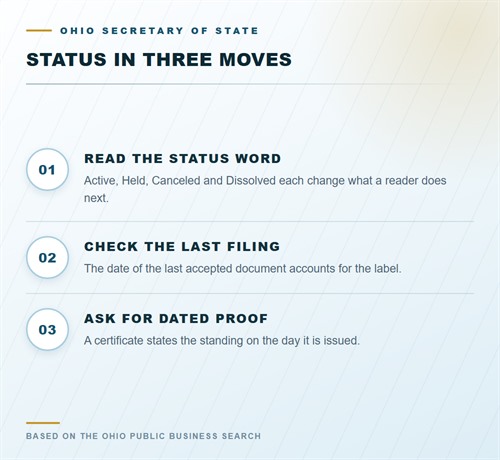
Ohio Secretary of State, Business Services Division, public business search:
https://businesssearch.ohiosos.gov/
Active
Active describes a company the office regards as in existence and in good order on the date shown. Reports are filed, the statutory agent appointment stands, and no office action has paused the file. It is the only one of the four words that supports an assumption the company can sign in its own name today. The word still says nothing about solvency, licensing, or how the business treats its customers.
What Active Does Not Certify
A company can read Active and still owe a supplier, miss a payroll, or work without a local permit. The state file tracks corporate housekeeping rather than commercial conduct, which is why a status check belongs beside credit references and contract terms instead of in place of them. Active is one item on a list, not a verdict on the business.
How Long the Word Lasts
The word holds only while the record stays current. A missed report, an agent appointment that lapses, or a filing that ends the company can move the record to another word, and the change appears once the office processes it. Earlier periods are not erased: the filing history keeps the date on which each document landed and the date the status changed.
Active on the Day of Signing
A contract signed while the field reads Active is signed against a company with authority to act, but the word can move before the work is finished. A buyer who needs cover across a long engagement may check again at each renewal, and a landlord may check before each option period. Repeating the lookup costs nothing and keeps the file current.
Held
Held marks a file the office has paused. The company still appears in the search, the entity number still resolves, and every document already accepted stays on file, but some pending matter keeps the record from resting at Active. A reader who finds Held should treat the company as unresolved rather than finished and should open the filing list to look for the cause.
Why a Record Sits on Hold
The reason is usually visible in the history. A document the office questioned, an agent appointment that came apart, or a filing that needs a correction before acceptance will all produce the word. Held is a holding position rather than a final judgment, and the office returns the record to Active once the missing item arrives. The history shows the pause and the release.
Held in the Middle of a Deal
A buyer who finds Held on the morning of a closing has two reasonable paths. One is to ask the company for the office notice and a date when the matter will clear. The other is to place funds in escrow until the status returns to Active. Signing while the file is paused leaves the buyer exposed if the company never resolves the issue.
Canceled
Canceled applies to a registration that has ended without a winding up in Ohio. The word appears most often on the Ohio record of a company formed in another state, whose authority to do business here was surrendered or withdrawn. The home-state company may still trade elsewhere, so a reader who stops at Canceled can reach the wrong conclusion about the business as a whole.
The Foreign Registration
A company from another state registers by naming the home state, the registration number held there, and an Ohio agent who accepts the appointment in writing. When that registration ends, the Ohio file is marked Canceled and the company loses its authority to transact business here. The file stays in the search so old contracts and old letterhead can still be traced.
What to Check Next
The home-state registry is the place to confirm whether the business still exists after an Ohio cancellation. A supplier that gave up its Ohio registration may be trading through a subsidiary, a trade name, or a newly formed entity. Each would carry its own record, and the name on the contract should point to the one that is actually bound.
Withdrawal and Office Action
A company can end its own Ohio registration by filing a withdrawal, and the office can act on its own when a foreign registration falls out of compliance. Either path ends with the same word on the record. The filing list separates the two, because a withdrawal carries the company’s signature while an office action carries a notice.
Dissolved
Dissolved marks the end of a company formed under Ohio law. The office records it after the company files articles of dissolution or after an administrative action closes the file. A dissolved company no longer holds authority to carry on business, though it may still take the limited actions needed to collect what it is owed, pay its debts, and hand the remainder to its owners.
Voluntary Dissolution
The company starts a voluntary dissolution by filing articles with the office, usually after a vote of its members or directors. The filing states an effective date and confirms that debts and liabilities have been provided for. Once accepted, the status changes and the record stops being a place where the company can claim new authority to act.
Wind-Up After the Filing
Winding up is the work that follows the vote: collecting receivables, settling claims, and moving what is left to the owners. The office does not supervise that work, and the record does not show whether it finished. A creditor holding an unpaid bill looks to the company, its contracts, and the courts rather than to the status field.
Administrative Dissolution
The office can also close a record on its own when compliance lapses and the company does not correct the problem after notice. No vote is taken and no articles arrive from the company, so the history shows a notice rather than a filing signed by an officer. A record closed that way can still be reinstated.
Reinstatement
A dissolved or canceled record can sometimes be brought back. Reinstatement is a filing rather than a phone request, and the office accepts it when the company clears whatever ended the file, such as missed reports and the charges attached to them. The same entity number returns, and the record keeps the formation date it had at the beginning.
What Reinstatement Restores
The company resumes the identity it held before: the same name, the same number, the same history. The gap between dissolution and reinstatement stays visible, and a reader can see the company was not in existence for a stretch. Contracts signed inside that gap deserve a second look, because the company lacked authority when they were made.
The Gap in the Record
Lenders and landlords tend to ask about any gap they notice. A short lapse cured within weeks reads differently from one that lasted years, and the record supplies the dates without supplying a reason. A company preparing to answer such a question should gather the office notices and the reinstatement receipt before the subject comes up.
Reading the Reinstatement Entry
The entry names the company, the date the office accepted the request, and the effect of returning the record to Active. It sits below the dissolution entry, so a reader scanning from the bottom sees the closing and then the return. Nothing about the file is rewritten, and the two dates remain available for anyone comparing them.
The Annual Report and the Status Line
Ohio requires an annual report from every LLC and every corporation, and the deadline is April 1. The report restates the principal office, the statutory agent, and a contact address, and no filing charge applies. Missing the date does not alter the status that same day, but a record that stays out of compliance can be acted on, and that action is what moves the word.
What the Report Confirms
A filed report is evidence that the company was reachable and organized on April 1 of that year. It names an agent who has accepted the appointment and gives the office a place to send notices. The report does not restate owners, and it does not certify that the company is profitable, licensed, or free of debt.
Reading the Report Date
The detail page shows the most recent report on file, and the history lists the ones before it. A report dated two or three years back suggests a company that stopped keeping up, even where the status still reads Active. Comparing that date against the current one is among the faster checks a reviewer can run before approving a vendor.
A Stale Address on the Report
An agent who has moved without filing a change leaves the office sending notices to an address nobody reads. The report may restate the old address for a year or more before the problem surfaces. A reader who sees an address that looks residential or out of date should treat the appointment as worth confirming before papers are served.
How Status Appears in the Public Search
The public search opens on a name field, and a submitted name returns a list of rows with a status shown on each. A reader can scan several companies at once before opening any of them. The detail page repeats the word beside the entity number and lists each accepted filing with a document number and a date.
Name Search and Entity Number
A name search can return a dozen near matches, because Ohio registers names that differ by a word, a punctuation mark, or an entity ending. The entity number removes the ambiguity: it belongs to one company and never to a second. Anyone holding an invoice, a lease, or an earlier certificate should search by number rather than by the printed name.
Fields on the Detail Page
The detail page carries the legal name, the entity number, the county of the principal office, the effective date, the status, the statutory agent, and the filing history. A corporation also carries its charter number. Nothing there sits behind a login, and no payment is asked for a lookup. A reader can open the page as often as the question comes up, and each visit shows the record as it stands at that moment.
Verifying a Supplier Before a Contract
A status check is a small piece of due diligence inside a larger file. Before a first order or a deposit, a buyer can confirm that the name on the quote belongs to a company the state recognizes, that the agent appointment stands, and that the record is current. The check takes minutes and leaves a dated impression of what the file showed.
Matching the Name on the Contract
The name on the contract should match the legal name in the state file, including the ending that marks the entity type. A quote issued under a trade name belongs to the company that registered it, not to a separate business. Where the two names differ, a buyer should ask which entity is signing and check that entity’s record.
A Second Record for the Trade Name
Ohio registers trade names on a five-year cycle, and each one appears in its own record tied to the company that owns it. A supplier trading under a shortened name will usually have both records. Checking the trade name leads back to the legal entity, and that entity is the party a contract should name in its signature block.
Checks That Reach Beyond the Register
The register settles the corporate questions and leaves the commercial ones open. A buyer may ask for references from two customers, a certificate of insurance naming the buyer as an additional insured, and a signed statement confirming the entity’s authority to do business in Ohio. Those documents sit with the company rather than with the state.
Dated Evidence and What It Proves
A screenshot or a printout is not an official document, but it fixes what the record showed on a given day. Reviewers ask for one because it can be filed and compared later. Printing the detail page with the date and entity number visible is enough for most internal approvals and for many vendor onboarding packets.
A Printout and What It Shows
The printout carries the status, the agent, the report date, and the filing list as they stood when the page was saved. It proves little about the past beyond the dates printed on it and nothing at all about the future. Its value lies in the timestamp, because a later dispute can be measured against what the record said at signing.
When a Certificate Is Needed
Some reviewers will not accept a printout. Banks, out-of-state boards, and parties to a closing often want a certificate of good standing, issued on the office’s letterhead with a date and a signature. A certificate speaks as of its issue date, so one ordered months ago may be refused at a closing where the reviewer wants a recent document.
Keeping the Evidence Together
A printout filed on its own loses much of its force. The file is stronger when the page sits beside the contract it supports, the vendor’s contact details, and any certificate the company supplied. A reviewer who returns to the folder a year later can then see exactly which record was checked and which papers followed it.
Charter Numbers, Entity Numbers, and Match Risk
A corporation’s record carries two identifiers. The entity number is assigned when the articles are accepted, while the charter number is the older label tied to the charter itself. Both resolve to the same company, and either one can be used in a request to the office. A reader who finds a charter number on an old stock certificate can still trace it.
Where the Charter Number Appears
Older filings, stock certificates, and bank signature cards often print the charter number instead of the entity number. The public search accepts either, and the detail page shows both. When a number returns nothing, a transcription error or a dropped digit is the likely cause rather than a company that has vanished from the register entirely.
Match Risk in a Name Search
Names are the weakest way to identify a company. Ohio allows names that differ only by punctuation or by the entity ending, and a search can return several of them in a row. The entity record page opens each row into the full file, and the number on that file is what belongs in a contract.
Number Formats and Leading Zeros
The office prints numbers as a run of digits, and older systems dropped a leading zero when a number was keyed by hand. A search that returns nothing for six digits may return a record for seven. Trying the number with a zero in front costs a moment and often resolves a record that looks missing.
Lookup and Certificate Charges
Two products carry a charge inside a status review: the certificate of good standing and a certified copy of an accepted document. The lookup itself is free. Expedited handling applies to filings rather than to searches, and the amounts below are the ones the office publishes for the items a reader is most likely to order.
| Item | Amount |
|---|---|
| Public search | $0 |
| Certified copy of a filing | $5 |
| Standing certificate | $5 |
| Agent update | $25 |
Frequently Asked Questions
The answers below cover the points that prompt a status check. The prices below apply to entities recorded with the Secretary of State, and each figure appears in the schedule rather than the text. Details about one company come from that company’s record, and a reader holding a filing should compare it against the detail page.
What do the four status words mean?
Active marks a company in existence and in good order, Held marks a file the office has paused, Canceled ends a registration without an Ohio wind-up, and Dissolved closes a company formed here. Only Active supports a current assumption of authority.
Is the public search free to use?
Yes. The Secretary of State’s business search asks for no account and no payment. Charges apply only to documents the office issues, such as a certificate of good standing or a certified copy of an accepted filing.
Does Active mean a company pays its bills?
No. The field tracks corporate housekeeping, not commercial conduct. A company can hold Active status while carrying debt, missing payments, or facing a lawsuit, so the word should sit beside credit and reference checks.
Can a dissolved company return to Active?
Sometimes. The company files for reinstatement and clears the items that ended the record, including missed reports and related charges. The same entity number returns, and the history keeps both the dissolution date and the date of return.
How should I check a supplier before signing?
Search by the legal name on the contract, then confirm the entity number, the status, the statutory agent, and the most recent report date. Save a dated printout with the file.
Does the status field name the owners?
No. Ohio does not publish member or shareholder lists on the entity record, and the annual report does not collect them. Equity and member records remain with the company itself.