

Every Ohio business begins with a document filed with the Secretary of State, and every later change to that business generates another one. Formation papers, amendments, agent updates, trade name registrations, and the annual report all pass through the same office and land in the same filing history. Knowing that sequence keeps a company from leaving gaps that later surface as a status problem at the worst possible moment.
The sections below describe what each document does, when it is due, how the office handles review, and what happens when a submission comes back. Fee amounts sit in a single table near the end rather than being scattered through the text.
Where Ohio Business Filings Are Submitted
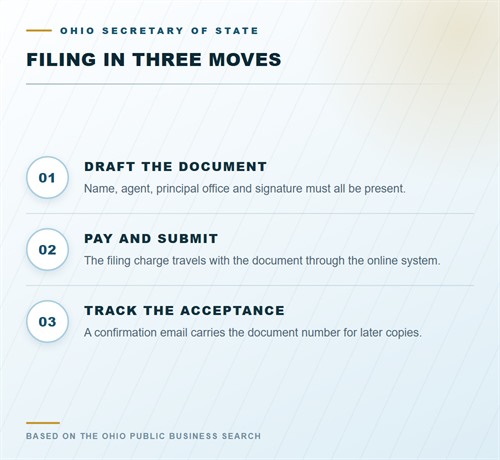
Documents go through the state’s electronic filing service, with paper forms accepted as an alternative. The division’s Columbus office processes what arrives. Routine submissions are reviewed in the order received, and a confirmation returns by email once a filing is accepted. The public The acknowledgment email that follows carries the document number, so keep it with the record for later copies and amendments. Ohio Business Filings register shows the outcome of that work.
Forms, instructions, and the online filing system:
https://www.ohiosos.gov/businesses/
Articles of Organization for an LLC
A limited liability company comes into existence when articles of organization are accepted. The document names the company, states its principal office, identifies the statutory agent, and declares whether members or managers will run it. The name must be distinguishable from existing registrations, which is why a name check comes before the submission rather than after it. A rejected name costs a filing cycle that most new businesses cannot afford.
Name Checks Before Submission
Ohio rejects a name that is indistinguishable from one already on the register. A search of the proposed name before drafting shows whether a conflict exists, and a name reservation holds the chosen name for 180 days while other documents are assembled. The reservation does not form the company, and the articles still have to be filed and paid for.
Filing Without an Attorney
Ohio does not require an attorney to form an LLC, and the online system is built for direct use by owners. The tradeoff is that the filer absorbs the review work: checking the name, confirming the agent’s acceptance, and matching the charge to the document. A returned filing costs more time than a careful first draft.
What the Articles Must Contain
The form calls for the entity name, the agent’s name and Ohio street address, a signed acceptance from that agent, the principal office, and the organizer’s signature. Fields left blank are treated as defects rather than as optional entries. A complete draft moves through review without a return trip and without a second submission charge.
Effective Date on Acceptance
The effective date is the day the office accepts the document, unless the filer asks for a later date within the window Ohio permits. A company that needs to align formation with a contract, a lease, or a bank closing should plan the submission around that date rather than assume it can be adjusted afterward.
Articles of Incorporation for a Corporation
A corporation files articles of incorporation instead of articles of organization. The document states the purpose, the authorized share structure, the agent, and the incorporators. Once accepted, the company receives two identifiers, an entity number and a charter number, which stay with it for life. Later documents quote one or both of them.
Authorized Shares
The articles state the number of shares the corporation is authorized to issue and the classes or series into which they are divided. That number sets a ceiling. Issuing more than the articles allow requires an amendment first, so the figure should reflect the company’s plans for several years rather than its opening position alone.
Incorporators and Initial Directors
The incorporator signs the articles and may be the only person named at that stage. Directors are elected afterward, either by the incorporator or by the shareholders, and the minutes record the choice. Ohio filings do not require a list of directors, so the public record may show no officer names at all.
The Charter Number Assigned
The charter number is unique to corporations and appears alongside the entity number on the record. Both numbers are quoted on certificates and on later filings. A lender or a title agent may ask for the charter number specifically, and the entity record supplies it without a separate request to the office.
Foreign Corporations Registering in Ohio
A corporation formed in another state registers here before transacting business, and the process uses a different form from the one an Ohio company files at formation. The registration names an Ohio statutory agent, whose street address goes on the record, and it carries the standard charge. The Ohio file then receives a new entity number while the charter number stays with the home state.
Amendments to Filed Documents
When a company changes its name, its address, or a provision recorded at formation, it files an amendment. The amendment does not replace the original document; it attaches to the record and appears as a separate entry in the filing history. Anyone reading the file later sees the original and the amendment in sequence, which preserves the trail even after the change.
Name Change Amendments
A legal name change is filed as an amendment and carries its own charge. The new name must still be distinguishable from other registrations, so the same check that precedes formation applies again. After acceptance, the record shows the current name while the history preserves the earlier one, and trade names filed under the old company remain attached.
Address Changes and Agent Updates
A change to the principal office is handled differently from a change to the agent. The principal office appears on the annual report and on amendments, while the agent’s address belongs to the agent’s own filing. Treating the two as one item leaves half the record stale and sends mail to the wrong place.
How the History Reads
The history lists document types and dates in order, which makes the company’s timeline legible at a single view. A reader can trace formation, an amendment, an agent change, and a series of annual reports without opening any document. What the history cannot show is the content of those filings or the reasoning behind them.
The Annual Report and Its April 1 Deadline
Both entity types owe a yearly report on April 1, and the office collects nothing for it. The report confirms the agent, the principal office, and the contact details already on file. It is short, it is filed every year, and it is the item that slips first once a company settles into routine operation and stops thinking about paperwork.
What the Report Confirms
The report restates the agent’s name and Ohio street address, the principal office, and the company’s contact information. If any of those details changed during the year, the report is where they surface. Filing it on time keeps the record accurate without a separate amendment and without a gap in the history.
Reports Filed After an Amendment
An amendment accepted in September changes the name or address on the record at once. The annual report filed the following April should reflect the amended details, not the original ones. Where the two disagree, the office may still process the report, but the mismatch stays visible to anyone reading the file.
Reports and a Company in Held Status
A company marked Held is not barred from filing its report. Submitting the outstanding report is normally what restores standing, and the office updates the status once the filing is processed. The report itself carries no charge, though a different document may still be outstanding.
Missing the April 1 Date
A late report does not dissolve the company on its own. It does move the record toward a Held status, which lenders, landlords, and title companies treat as a warning sign. Filing the report clears the problem, though the delay stays visible in the filing history for anyone who reads the dates.
Reports for a Company That Changed Its Name
A report filed after a name change should carry the current name. Where the filing still shows the old one, the office may return it or accept it with a correction later. Matching the report to the most recent accepted document avoids a mismatch that a reviewer would have to untangle.
Updating the Statutory Agent
The appointment must name a real Ohio location, not a postal box. A written acceptance from the agent is filed with the office. When the agent changes, or when the agent’s address changes, the company submits an update so the public record matches the people actually receiving official mail. The charge appears in the table below.
Agent Acceptance
The acceptance is a signed statement that the agent agrees to serve. It accompanies the update and is not optional, even when the same firm has represented the company for years. A filing that omits it is returned, and the record keeps the previous agent until a corrected submission is accepted by the office.
Commercial Agent Services
Many companies name a commercial service as statutory agent rather than an owner or an employee. The service holds an Ohio street address, signs the acceptance, and forwards official mail. The arrangement does not remove the company’s duty to keep the record current, and a lapsed account can leave notices unclaimed for months.
When an Agent Resigns
An agent who resigns files notice with the office, and the company then has a limited window to name a replacement. During that window the company is exposed, because official notices go to an address no one is watching. Naming a successor promptly avoids a gap that later shows up as a missed deadline.
Registering a Trade Name
A business operating under a name different from its legal name registers that name as a trade name. Registration runs for five years. The filing identifies the underlying entity and the name it will use in public. Trade names carry their own set of rules, covered on a page about Ohio DBA and trade name registration and how those entries appear in a search.
When a Trade Name Filing Applies
The filing applies whenever the public name differs from the name on the formation documents, whether the difference is a shortened version, a brand, or an unrelated label. A company trading under several names registers each one separately. The registration does not create a new entity or shift any liability away from the company.
One Name Across Several Locations
A business with several locations may use one trade name across all of them or a different name at each. The registration follows the name rather than the address, so one filing covers every location using it. Adding a second name means adding a second registration with its own term and expiration date.
Preclearance Review
Preclearance lets a filer submit a draft for review before the formal filing. The office checks format, name availability, and the completeness of required fields, then reports what would need correction. The service is optional and does not reserve the name, but it lowers the chance of a rejection on a document tied to a closing date or a contract deadline.
When Preclearance Is Worth the Charge
The service earns its cost when a document has a fixed deadline and no room for a second attempt. Complex amendments, conversions, and mergers benefit most, since those drafts carry more fields where a defect can hide. A single-page agent update rarely needs the extra review.
What Preclearance Does Not Cover
The review addresses form and name conflicts, not the business judgment behind a document or its compliance with other agencies. Tax registration, professional licenses, and local permits sit outside the Secretary of State’s review. A cleared draft still has to be filed as a formal submission and paid for at the standard rate.
Expedited Handling Options
Standard processing follows the queue. A filer who needs faster turnaround selects one of three expedited tiers, and the office moves the document ahead of routine work. The tiers differ only in speed. Expedited handling does not change the review standard, so a defective document is returned regardless of which tier was purchased for it.
Turnaround and Filing Volume
Processing speed depends on how many documents the office has in front of it, and volume shifts through the year. Filings cluster around the April 1 report date and around the end of a calendar quarter. Submitting ahead of those peaks often beats paying for a faster tier during one.
Expedited Handling After a Rejection
An expedited request attached to a document that is later rejected does not carry over to the resubmission. The second attempt starts at the back of the queue unless a new expedited charge is paid. Building a small margin into a deadline protects against that outcome.
Choosing a Tier
The tiers are two-day, one-day, and four-hour. The choice usually follows an external deadline such as a closing date or a contract start. Paying for speed on a document that is still being drafted wastes the charge, so the draft should be finished and checked before the expedited request goes in.
Rejection and Resubmission
A rejection states the reason and returns the document without an effective date. Frequent causes include a name that conflicts with an existing registration, a missing agent acceptance, an incomplete signature block, and a charge that does not match the document type. The filer corrects the item and submits again, and the office treats the corrected version as a new submission.
Frequent Defects
Name conflicts lead the list, followed by agent details that fail the street address rule. Signature blocks go unsigned when a company assumes an electronic check will cover it. A mismatch between the form selected and the document attached also draws a rejection, and that one is the easiest to prevent before anything is uploaded.
Correcting a Name Conflict
A conflict arises when the proposed name is indistinguishable from one already registered, including differences of punctuation or a plural ending. The fix is a new name rather than a revised form. Reserving an alternative before resubmitting keeps the second attempt from failing for the same reason.
Resubmitting a Corrected Document
A resubmission must carry the full document, not only the corrected page. Submissions that arrive without the original attachments are usually returned again. Keeping the rejected version and the notice together preserves a record of what changed between attempts, which matters when a deadline depends on the outcome.
Signature Problems
An unsigned or improperly signed document is returned even when every other field is correct. The signature must come from someone authorized by the company, and an electronic signature is accepted where the system allows it. Retyping a name into a signature field does not satisfy the requirement.
Filing Fees Set by the Office
Amounts below are the statutory charges collected by the Secretary of State. Expedited fees are added to the filing charge rather than replacing it, and a document resubmitted after a rejection is charged again at the same rate as the first attempt.
| Item | Amount |
|---|---|
| Formation, LLC | $99 |
| Formation, corporation | $99 |
| Yearly report | $0 |
| Agent change | $25 |
| Reserved name | $39 |
| Trade name filing | $39 |
| Rush, two-day | $100 |
| Preclearance | $50 |
Frequently Asked Questions
The questions below address timing, charges, and the details that stall a submission most often.
Is the annual report free to file?
Yes. The annual report for an LLC and for a corporation is due April 1 and carries no filing fee. The report still has to be submitted, because skipping it affects standing even though no payment accompanies it.
Can I file before the name is confirmed?
A name reservation holds a name for 180 days while documents are prepared. The preclearance option reviews a draft for defects before submission. Neither guarantees acceptance, but both lower the risk of a rejection.
What happens if a filing is rejected?
The office returns the document with a stated reason and assigns no effective date. The filer corrects the problem and submits the complete document again. The resubmission is charged at the same rate as the first attempt.
Does expedited handling guarantee acceptance?
No. Expedited tiers change a document’s place in the processing queue, not the review standard. A document with a name conflict or a missing agent acceptance is returned even at the highest tier.
How is a statutory agent changed?
The company files a statutory agent update naming the new agent and giving that agent’s Ohio street address, since a post office box is not permitted. A written acceptance from the new agent accompanies the filing.
Do amendments replace the original document?
No. An amendment is added to the record alongside the original, and both remain visible in the filing history. Readers see a sequence of documents rather than one consolidated version.
Keeping the Record Consistent
Filings that agree with each other are easier to verify. When the agent address, the principal office, and the annual report all match, a third party reviewing the file has nothing to reconcile. Divergence between documents is not a violation in itself, but it invites questions during due diligence and slows approvals that depend on the Ohio entity record showing a clean status.