

A certificate of good standing is the paper a bank, a licensing board, or a counterparty asks for when it wants proof that a company exists under Ohio law and is current with the state. The Secretary of State issues it on request, dates it, and signs it. One page carries the legal name, the entity number, and the office’s confirmation as of that date.
This page sets out what the certificate certifies, what it leaves out, the situations that call for one, and the routes for ordering it. It also covers the difference between the certificate and a plain printout, certified copies, apostilles for use in another country, and the charges the office applies. Amounts sit in a single table near the end.
What the Certificate States
The Ohio Certificate of Good Standing is a single page issued by the Secretary of State that states a named company exists under Ohio law and has filed the reports the office requires as of the issue date. It carries the legal name, the entity number, the date of issue, and the signature of the filing officer. Banks and out-of-state agencies treat it as standard proof that a company is alive and in order.
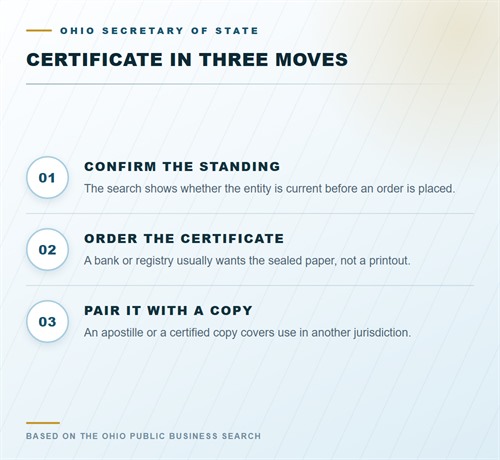
Ohio Secretary of State, Business Services Division, business filings and certificates:
https://www.ohiosos.gov/businesses/
Who Can Request One
Any member of the public can order the document, and no showing of interest is required. A lawyer, a lender, a competing business, and the company itself all follow the same route and pay the same charge. The office does not ask why the page is wanted, and it does not notify the company that a request was made.
What the Certificate Leaves Out
It says nothing about money. A company can hold a clean certificate while carrying debt, losing customers, or defending a lawsuit. Nor does the page list officers, directors, members, or subsidiaries, and it does not confirm that the company holds a license for the work it advertises. A reader who needs those facts collects them elsewhere and uses the certificate for the narrow point it settles.
Fields Printed on the Page
The page names the company exactly as the record holds it, gives the entity number, and states the office’s conclusion. A corporation’s page may also show the charter number. The issue date and the signature line are the two features a careful reviewer checks first, because they tie the statement to a moment and to an official.
The Issue Date Sets the Boundary
A certificate speaks to one moment. A filing accepted the following week, a report that lapses in the spring, or a dissolution voted at a meeting all fall outside what the page can tell a reader. The date is printed on the document for that reason, and a reviewer who accepts an older copy accepts a statement about the past.
Items Confirmed Separately
Insurance, bonding, permits, and tax registration sit outside the certificate, and so does the question of who may sign for the company. A closing checklist often pairs the page with a board resolution, a tax clearance from another agency, or a good-standing letter from the home state of a foreign company. None of those items appear on the page.
A Statement About the Office, Not the Trade
What the page records is the office’s own handling of a file: documents accepted, reports received, no closing recorded. It is not a character reference for the business and not a signal that the company pays on time. Buyers who need commercial assurance order trade references or a credit report, which measure something the state never sees.
When a Bank Asks for One
The most frequent request comes from a bank. A certificate supports an account title, a credit application, or a guarantee signed by the company, because the bank wants to know that the entity on the signature card is the entity the state recognizes. The document does not replace a credit decision, and no banker treats it as one.
Opening a Business Account
Account opening usually calls for the certificate, the articles, an employer identification number, and a resolution naming the signers. Some banks accept a printout from the state search, while others insist on the sealed page. Asking the banker which documents will be accepted prevents a second order and a delay at the branch, since requirements differ from one institution to the next.
A Commercial Loan File
A loan file tends to want a certificate dated within a short window before closing, often thirty days. The requirement protects the lender from relying on a document that predates a change in the record. Where the closing slips past that window, the lender may ask for a fresh copy rather than accept the one already on file.
Guarantees and Signature Cards
A personal guarantee from a company officer travels with a certificate for the company and, where relevant, one for a parent entity. The signature card names the individuals and the titles they hold. The certificate confirms the company, the resolution confirms authority, and neither one does the other’s work. Where a guarantee names a subsidiary, that company needs a page of its own.
Authority to Sign
A certificate names a company, not a person. The officer who signs the account documents needs a resolution or an operating agreement that puts the pen in hand. Banks ask for both because a valid company with no authorized signer still cannot open an account, and the two papers answer different questions. Both are usually requested at the same meeting.
Leases and Landlord Requests
A landlord leasing space to a company often asks for the page before signing, and a tenant signing a long lease may ask for the landlord’s own certificate. Either request is a check on the entity rather than on the balance sheet. A tenant that cannot produce one may be asked for a personal guarantee instead.
Licensing Boards and Out-of-State Registries
Out-of-state agencies ask for the page as part of a registration. A contractor board, a professional board, or a secretary of state in another jurisdiction may require proof that the company is in good standing where it was formed. The same page often travels with an application for authority to do business in that second state.
Registration in Another State
A company expanding across a state line files an application in the new jurisdiction, and the application often attaches a certificate from Ohio. The receiving office wants assurance that the company has not been dissolved at home. Several states set a maximum age for the document, counted from the issue date. The application and the certificate travel in the same packet.
Public Bids and Vendor Lists
Bids for public work often require a certificate with the submission. A purchasing office uses it to confirm that the bidder is a registered entity rather than an unincorporated name. A bid that arrives without the page can be set aside on that ground alone, whatever the merits of the price. The issue date is often compared against the bid opening date.
Professional and Occupational Boards
A board that licenses the work itself may also ask for the certificate before it renews a license held by a company. The board is checking corporate existence, not competence. Where a company has changed its name, the board may want the amendment as well, so that its own file and the state record agree.
A Second State’s Own Requirements
Every jurisdiction writes its own application rules. One may want the certificate attached to the filing, another may want it signed by an officer of the company, and a third may ask for a second certificate from the company’s home state. Reading the receiving office’s instructions first avoids an order that has to be repeated.
A Certificate for a Subsidiary
A parent company registering in another state may be asked for a page covering each subsidiary that will do business there. Each is its own entity with its own number, so each needs its own document. One request can name several companies, and the office returns a page for every one of them, each carrying its own issue date.
Ordering Routes and What to Send
Requests go to the Business Services Division in Columbus. The office takes orders online and by mail, and each route asks for the legal name and the entity number. Online orders usually return sooner because the request reaches the desk without a mailroom stop and the charge can be paid at the same time.
What a Written Request Should Carry
A mailed request should name the company exactly as the record holds it, give the entity number, state what is wanted, and include payment and a return address. A cover letter helps when several documents are ordered for one closing. The office matches the request to the file by number, which is why the number matters more than the name.
Expedited Tiers
The office sells handling in tiers measured in days and hours, and the charge is added to whatever the document itself costs. A four-hour request is timed from the moment the office logs the item rather than from the moment it is mailed. Expedited service buys position in the queue, not a different review of the file.
Confirming the Order Arrived
An order that has not arrived by the promised date deserves a call to the office with the receipt in hand. The receipt carries the date the request was logged, which is the date the office measures against. A duplicate order placed without that call costs a second charge and does not speed the first one along.
Certificate Against a Plain Printout
The public search page prints for free, and plenty of reviewers accept that printout. The certificate differs in three ways: it is issued on office paper, it carries a signature and the state seal, and it states a conclusion rather than displaying a database. A printout shows what the screen held, while the page is the office’s own written statement.
Seal, Signature, and Letterhead
Third parties read those marks as evidence that an official looked at the file. A screenshot can be altered, and a recipient has no way to tell. The format, the date, and the signature line make the document harder to fake and easier to check with the issuing office when a doubt arises. A recipient who wants confirmation can call the office and read the entity number back.
Where a Printout Will Do
Internal approvals, vendor onboarding, and preliminary checks often take a printout. The status record page on this site covers how to read one and what to keep with it. A closing, a bank file, or a licensing packet usually calls for the sealed document instead, and the request should say which one is wanted. The recipient’s checklist usually names it outright.
Comparing the Two Side by Side
Place the printout next to the certificate and the gap between them is plain. The printout repeats a web page, complete with its navigation and its search box. The certificate sets out a sentence about the company on blank paper, without a menu, a date field to interpret, or a second record to compare. Reviewers read them differently for that reason.
Certified Copies in the Same Request
A certified copy reproduces an accepted filing and carries a stamp confirming that it matches the office file. Where the certificate answers whether the company exists, the certified copy answers what a specific document said. Closings, litigation, and out-of-state registrations often ask for both, and the two are ordered together. Neither alters the file, and neither takes the place of the other.
What the Certification Adds
The stamp and signature let a reader rely on the text of articles, an amendment, or a dissolution. An uncertified copy from the search page may be accurate and still be refused by a title company or a court clerk. The certified version settles authenticity and leaves only the question of what the words mean.
Naming the Documents
One request can cover the certificate and certified copies of several filings. The business records page on this site describes how the history is arranged, which helps a requester name the documents wanted. Listing each one by number and date keeps the order from coming back for clarification, and one cover letter can serve the whole request.
Cost and Turnaround for Both
Certified copies carry a charge for each document, and the certificate carries its own. Both tend to come back on the same schedule when ordered together. One request saves a mailing and keeps the dates aligned, which matters when a closing file is assembled in a single sitting. A second request placed later will carry a later date.
Apostille for Use Abroad
A company that needs the page in another country usually needs an apostille as well. The apostille is issued by the Ohio Secretary of State and attached to the certificate, and it confirms the signature of the official who signed the page. Countries in the Hague Convention accept an apostille in place of consular legalization.
One Office, Two Documents
The agency that issues the certificate issues the apostille, and the two are requested together. A request that arrives without the certificate cannot be completed, because the apostille covers a signature on an existing document. Sending both items in one envelope shortens the round trip, avoids a second mailing, and keeps the two papers together when they reach the foreign registry.
Names and Translation
A foreign registry may want the company name spelled as the record holds it, without translation. Where a translation is required, it usually comes from a certified translator rather than from the state. The certificate stays in English, and the apostille page names the document it covers. A translated copy travels beside it, never in place of it.
When Legalization Replaces the Apostille
A country outside the Hague Convention may require consular legalization instead. That route runs through the embassy or consulate of the receiving country after the state has certified the signature, and it takes longer than an apostille. The receiving party’s instructions name which route applies to the filing, and the sequence can add several weeks to the schedule, which a closing calendar rarely allows.
Dates, Expiry, and Re-Ordering
Ohio does not print an expiry date on the certificate. Reviewers set their own windows instead, and thirty or sixty days from the issue date are frequent limits. A copy ordered for a closing that is later rescheduled may need to be replaced. Keeping the receipt with the document helps when a reviewer asks how old it is.
No Fixed Term
Nothing in the document states a period of validity. The page describes the record on its issue date, and the record can change the next morning. A reviewer who accepts a copy that is a year old is making an assumption about the months since, and the assumption may not hold. The date at the top is the only clock printed on the page.
Timing a Closing Order
A closing calendar usually sets the order date. Certificates for a bank file are often requested a week or two before signing, which leaves room for a correction if the name on the request does not match the record. Ordering on the last day leaves no time to fix a mismatch, while a cushion of a few days costs nothing.
A Certificate for a Recurring File
A company that supplies the same bank or agency for years may be asked for a fresh page at each review. Nothing carries over from the earlier cycle, because each one speaks to its own date. A folder of past certificates is useful for showing that the company stood in good order at each renewal, but never for the current period.
Mismatched Names and Corrections
A request that names the company slightly differently from the record can return a document for another entity or none at all. The office works from its own file, so the legal name, the entity ending, and the number must line up. A trade name is not the legal name, and no separate certificate exists for a trade name as such.
After a Legal Name Change
Older certificates carry the former name. A bank holding one may ask for a copy of the amendment that made the change, along with a current document. The filing history shows both names, and the entity number stays the same across the switch, which is how the two papers are tied together. Both should travel in the same packet.
Correcting the File First
When the record itself is wrong, the cure is a filing rather than a new order. An amendment corrects a name or an address, and an agent update corrects the appointment. Ordering before the correction documents the error and postpones the fix to another day, which is the outcome nobody wants. A corrected file produces a clean page on the first attempt.
Entities With Similar Names
Ohio registers plenty of companies whose names differ by a single word, and a request built from a memory of the name can land on the wrong one. Before ordering, open the detail page and compare the number, the county, and the agent against the papers in hand. The number printed on the resulting page is the proof that the right entity was named.
Certificate Charges
The office publishes a charge for the certificate, for certified copies, and for the expedited tiers that move an order ahead in the queue. The table below gathers those amounts with the filing charges a company may need at the same time. The search itself remains free, and no payment is required to read a record.
| Item | Amount |
|---|---|
| Certificate of good standing | $5 |
| Certified copy | $5 |
| Agent update | $25 |
| Preclearance review | $50 |
Frequently Asked Questions
The queries below cover what a requester asks before ordering. Every charge below attaches to an entity on the Ohio register, and the figures sit in the schedule rather than in the prose. A specific order is best confirmed with the office, because a request that names the wrong entity comes back without a document.
What does the certificate prove?
The page carries the office seal and a date, and it confirms the entity stands in good standing on that day. Finances, owners, and licences fall outside its scope.
How do I order one?
Send a request to the division’s Columbus office, or order online. Give the legal name and entity number, state what is wanted, and include payment.
Will a printout from the search be accepted?
Sometimes. Internal approvals and vendor files often take a printout, while banks, courts, and licensing boards tend to want the sealed page with a signature and the state seal. Ask the recipient which will be accepted.
Does a certificate expire?
No expiry date is printed on it. Reviewers apply their own limits, often thirty or sixty days from the issue date, so a copy ordered months ago may be refused at a closing.
Does it list the owners?
No. The state record carries no member or shareholder list, and the certificate says nothing about ownership. A lender that needs owners asks the company for a statement or a resolution.
Can I use it in another country?
Usually with an apostille attached. The Ohio Secretary of State issues the apostille on the certificate itself, and countries in the Hague Convention accept it in place of consular legalization.