

Ohio keeps a limited liability company file from the day its articles of organization are accepted until the day the company is wound up and dissolved. That file carries the entity number, the effective date, the statutory agent, and a status word that tells a reader where the company stands. Anyone can read the whole record through the state’s public business search, and no part of the lookup requires an account or a payment.
This page follows the LLC record from formation to closing. It covers the articles of organization, the entity number, domestic and foreign companies, the statutory agent, the April 1 report, amendments, dissolution, and the four status words the office uses. Fee amounts sit in one table near the end rather than in the running text, and every procedural statement below comes from the Secretary of State’s Business Services Division.
The LLC File and What It Holds
A name search returns one row, and the row opens into a detail page. That page shows the legal name, the entity number, the county where the main office sits, the effective date, and the current status. The Ohio LLC Search tool on this site opens the same state file the Secretary of State keeps for every company in Ohio, and the results match what the office itself displays to the public.
Ohio public register, used here to check an LLC file:
https://businesssearch.ohiosos.gov/
Articles of Organization and the Entity Number
Formation starts with articles of organization sent through the state’s electronic filing service. The office stamps the accepted filing with an entity number, a seven-digit identifier that stays with the company for life. During a lookup that number settles the question, because it resolves to one company and never to a near match. A name can be mistyped or shortened by a clerk, but a number travels intact.
What the Articles Carry
The form asks for the company name, a principal office address, the name and Ohio street address of the statutory agent, and a signature. The organizer records a choice between member management and manager management, a decision that shapes how the company is run later. Filings reach the division’s Columbus address by mail, and the online system accepts them at any hour of the day.
Why the Entity Number Matters
Receipts, reports, and certified copy requests all ask for the entity number rather than the name. Numbers survive a name change and a move, so old paperwork still lines up with the current record. A name can shift by a single word and produce several close matches, but a number points to exactly one file. Keeping that number on hand shortens every later request to the office.
How the File Grows After Formation
Each accepted document lands in the record with its own document number and date. Amendments, agent changes, and reports stack in the order the office processed them, and the newest item usually sits at the top of the list. Nothing is overwritten, so a reader can see what the company looked like at an earlier point in its life. A record that is ten years old still shows its very first filing.
Correcting a Refused Formation Filing
A filing that arrives without the agent’s written acceptance, without a proper ending in the company name, or without a signature comes back with a notice pointing to the defect. The organizer fixes that item and submits the papers again. The entity number is assigned only when the office accepts the document, and a refused submission leaves no trace on the public register for a later reader to find.
Domestic and Foreign LLCs
The register holds two kinds of company. A domestic LLC was formed under Ohio law, and its articles sit in the same file as every later report. A foreign LLC was formed elsewhere and then registered to do business here, so its Ohio file holds an application for registration instead of formation documents. Both kinds carry an entity number drawn from the same series, and both appear in one search result.
The Ohio-Formed Company
For a domestic company the file opens with the articles of organization. The effective date shown is the day the office accepted the articles, which can differ from the day the organizer signed them. Amendments and reports follow in date order, and the entity number appears on each one of them. Nothing in that sequence is hidden from a reader who opens the record.
The Registered Foreign Company
A foreign LLC registers by naming its home state, its home-state entity number, and an Ohio statutory agent. Documents filed in the home state remain with that jurisdiction, so a reader who needs them must approach the company or its home office. If the home registration ends, the Ohio record can be canceled, and a new application is required before the company can do business here again.
Members and Managers Are Not on the Public File
Ohio does not publish LLC members on the entity record. The articles of organization do not ask for owners, and the annual report does not collect them either. Someone checking a company for ownership will not find it in the state file, although the business may publish that information on its own website or in a contract. The absence is deliberate, not an error in the listing.
What the Record Does Show
The detail page shows the statutory agent, the principal office address, the effective date, the entity number, and the status. Management appears only in a narrow sense: the articles state whether the company is member-managed or manager-managed. Every accepted filing is listed with a document number and a date beneath it, and each entry can be opened on its own for the full text.
Reaching Ownership Details Another Way
Ownership questions usually call for documents the state does not keep, such as an operating agreement or a signed contract. A records request reaches only what the office holds in its file. For a reliable statement of who owns what, the company or its counsel is the source, and the business search cannot supply an answer. A court filing may also name owners when a dispute reaches the docket.
The Statutory Agent on an LLC File
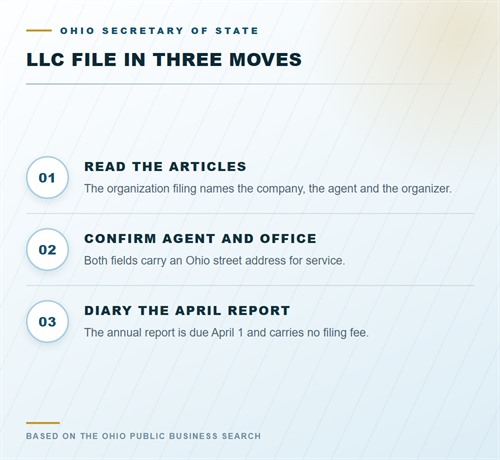
Every LLC names a statutory agent, the party that accepts service of process and official mail. A signed consent from the agent accompanies the appointment. Without that acceptance the appointment is incomplete, and the office can reject the filing that depends on it. The agent’s name and address then appear on the public detail page for anyone to read.
The Street Address Rule
The office refuses a postal box; the appointment requires a genuine location in the state. The address is printed on the public record so anyone serving papers knows where to deliver them. A mailbox service passes only if it holds a true street address where staff sign for deliveries. An address in another state fails the rule no matter how complete it looks.
Changing or Ending an Appointment
A company changes its agent by filing an appointment or change of agent, signed by the company and by the incoming agent. The same paperwork serves when an agent resigns from the role. Once the office accepts the filing, the new name and address appear on the detail page and in the history. Older filings keep the previous agent’s name as it stood at the time they were accepted.
What the Agent Is Not
Naming a statutory agent does not make that party an owner, a manager, or an employee of the LLC. The role is narrow: the agent accepts service of process and official mail and passes it along. A company can name an individual, a law firm, or a registered service, and the appointment ends when either side files the paperwork that ends it. The record shows the appointment, not the reasoning behind the choice.
The April 1 Annual Report
The filing calendar for an LLC includes one yearly submission, and the office expects it on April 1. No filing fee applies to the report. It repeats the main office, the accepting agent, and a contact address, which keeps the record accurate between formation and dissolution. It maintains the file rather than renewing the company’s existence, so the entity number never changes because of it.
What the Report Confirms
The report carries the principal office address, the agent’s name and street address, and a contact for the company. A company that has moved or replaced its agent can correct both in one filing instead of sending separate paperwork. The accepted report appears in the history with its own document number and date, and the status field stays as it was before the filing arrived.
Reports When Nothing Has Changed
A report is due every year whether or not anything about the company has moved. An LLC with the same address, the same agent, and the same contact still files by April 1, and the office still records the submission. Skipping a year because nothing changed leaves a gap that later readers will notice in the history. The filing takes minutes, and the confirmation belongs with the company’s own records.
Submitting the Report Early
The office accepts a report before April 1, and filing early removes the risk of a lapse during a crowded spring. A company that changes its agent in March can send the report afterward and carry the new name and address in a single submission. The office issues a confirmation once it takes in the report, and that notice is worth keeping beside the company’s other papers for the year.
The Nonprofit Schedule
A nonprofit corporation reports every five years, near the anniversary month of its formation, and pays a fee for the filing. A limited liability company reports each year by April 1, and no payment accompanies the filing. Organizations that hold both a nonprofit corporation and an LLC should keep the two calendars apart so neither filing slips past its date, since the two schedules rarely fall in the same month.
Amendments and Legal Name Changes
An LLC corrects its record with articles of amendment. The form can change the company name, the principal office, the management structure, or the effective date statement. The office attaches it to the original articles, so the record carries both versions and shows what changed between them. A reader never has to guess which text is current and which has been replaced.
Changing Text Already on File
An amendment states the current name, the entity number, and the exact wording being replaced. A reader can set the amendment beside the original articles and see what moved. Nothing is erased from the record; the file is a stack of accepted documents, each with a number of its own. The office does not rewrite an earlier page to match a later one.
Fixing a Clerical Error
A misspelled street name or a wrong county can be corrected by amendment when the mistake came from the company’s own submission. The office does not edit an accepted document on its own authority. Even a small correction travels through the same form as a larger change, and the amended text becomes the version future readers will see first.
A New Legal Name
A new legal name requires an amendment, and a charge applies to that submission. The new name must still satisfy the naming rules, including the required ending and the test that separates it from names already in use. The entity number stays the same through the change, so an old document and a new one lead to a single record.
What Does Not Change
A new name, a new office, or a new agent leaves the entity number and the original formation date alone. Filings made under the old name still sit in the same record, which matters when a lender reviews documents signed years apart. The history keeps every version of the company’s identity in order, with the oldest document at the bottom of the list.
Dissolution and Reinstatement
A company that stops doing business files articles of dissolution, which ends its existence under Ohio law. The filing follows the settling of debts and the distribution of what remains. The record then shows dissolved, and the history closes with the dissolution document until the office receives something further. Papers filed after that date are limited to a few narrow categories.
How Dissolution Shows on the Record
The dissolution certificate sits at the end of the filing history, and the status field changes. The office keeps the record open to the public, so a lender or a landlord can still see what happened and when. Documents accepted before dissolution stay readable, including the original articles and every report. A closed company is not erased from the register.
Returning to Active Status
A dissolved LLC can be reinstated, and the office restores the original entity number instead of issuing a new one. The record carries two dates, the closure and the restoration, so the gap stays visible to anyone reading the file. A company unsure what its reinstatement requires should ask the Business Services Division before it files, because the answer depends on the state of its record.
Status Words on an LLC Record
Four words appear in the status field: Active, Held, Canceled, and Dissolved. Active means the company is current with the office. Dissolved marks a company that filed to end its existence. Canceled applies to a registration that has been terminated, and Held marks a record the office is holding while an action is pending. The detail page shows only one of them at a time.
Status Beside the History
The status field is a summary, and the filing history is the detail behind it. A company can be active with an old address still printed on an earlier document, or canceled with a long record of reports behind it. Reading the two together prevents a wrong conclusion drawn from a single word. The most recent accepted filing usually shows why a status changed.
Checking Status Before a Contract
A person about to sign a lease or a supply agreement can check the status the same day. A company shown as dissolved cannot be revived by a phone call to the office, and a signature from it may mean little. A dated printout of the detail page gives a reviewer a record of what the file showed at that moment.
Certificates, Copies, and Preclearance
A third party usually wants one of two products: a standing certificate or a certified copy of a filed paper. Both come from the Secretary of State and carry the office’s seal. Preclearance lets a filer send a draft for a defect check before submission. Each one is ordered from the same office that holds the record.
A Certificate of Good Standing
A certificate of good standing states that the company exists and is current with its reports at the moment the office issues it. Banks, landlords, and out-of-state licensing boards often ask for one. The paper carries a date, so one issued months ago can fail a reviewer who needs the position as of today. Ordering a fresh copy before a closing avoids that argument.
Certified Copies and Preclearance
A certified copy reproduces an accepted document with a stamp confirming that it matches the office file. A preclearance review works differently: the office examines a draft filing before submission and points out defects, which saves a rejection later. Neither service alters the underlying record, and neither one substitutes for the other in a transaction that asks for a specific document.
Asking Which Document a Reviewer Wants
A bank, a landlord, and a licensing board may each want a different paper from the same file. One asks for a certificate of good standing, another for a certified copy of the articles, and a third for both. Asking the reviewer which document will be accepted saves an order that has to be repeated, and the answer is often printed on the closing checklist.
Ohio LLC Filing Fees
Every filing has a published price, and the list below covers the papers an LLC usually submits. Rush treatment carries its own price, paid in addition to the standard amount, and it must be submitted alongside the filing. Prices are adjusted now and then, so verify the published list before paying.
| Item | Amount |
|---|---|
| Articles of organization | $99 |
| Annual report, LLC | $0 |
| Statutory agent update | $25 |
| Articles of amendment, LLC | $50 |
| Name reservation, LLC | $39 |
| Trade name filing | $39 |
| Standing certificate | $5 |
| Certified copy | $5 |
| Preclearance | $50 |
| Rush, two days | $100 |
Expedited Handling
Expedited service moves a filing toward the front of the queue for the period purchased. A four-hour request is measured from the time the office logs the document, not from the moment it is dropped in the mail. The handling charge is added to the filing fee and buys speed rather than a different review of the paperwork.
Frequently Asked Questions
The queries below arrive most often from readers opening an LLC file. Each fee applies to a company on the Ohio register, and the amounts sit in the table above rather than in the text. Details about a specific company come from the record itself, not from a general answer, and anyone holding a filing should set it beside that entity’s record view.
Where do I search for an Ohio LLC?
Use the Secretary of State’s public business search at businesssearch.ohiosos.gov. Enter the company name or the entity number, open the matching row, and read the detail page. No account or payment is required for a lookup.
Does the LLC record list its members?
No. Member names are absent from the public file, and the yearly report does not collect them. Ownership details sit in private documents such as an operating agreement or a purchase contract held by the company.
When is the LLC annual report due?
April 1 of each year. No charge applies to the report, which sets out the office, the agent, and a contact address for the company.
Can a post office box serve as the agent address?
No. The role requires a physical Ohio address, and a signed consent from the agent is lodged with the division. A box number on its own will not satisfy either requirement.
What does Held mean on an LLC record?
A held file means the office has paused action on the record. It differs from Active and Dissolved, and the filing history usually shows the event that triggered the pause.
What happens to the file after dissolution?
The office marks the record dissolved and keeps it open to the public. A later reinstatement restores the same entity number, and the record shows the closure and the return as separate dates.