

A corporation’s Ohio record is built around a charter. When the Secretary of State accepts the articles of incorporation, the office assigns a charter number alongside the entity number, and either one leads to the same file. Everything the corporation later submits, from annual reports to merger certificates, joins that file in the order the office processed it.
The sections below trace the charter file from start to finish. They cover the articles, the two identifiers, domestic and foreign companies, officers and directors, the April 1 report, amendments, mergers, dissolution, and the certificate a bank will ask for before it lends. Corporate charges are collected in a single table near the end of the page.
Inside the Corporate Record
A search by name returns one row, and the row opens into a page with the legal name, the charter number, the entity number, the effective date, the principal office, the statutory agent, and the status. The Ohio Corporation Search page on this site reaches the state system that holds those details, and the display matches what the office shows to any visitor who looks.
Ohio Secretary of State, Business Services Division, for business filings, forms, and the fee schedule:
https://www.ohiosos.gov/businesses/
Articles of Incorporation and the Charter Number
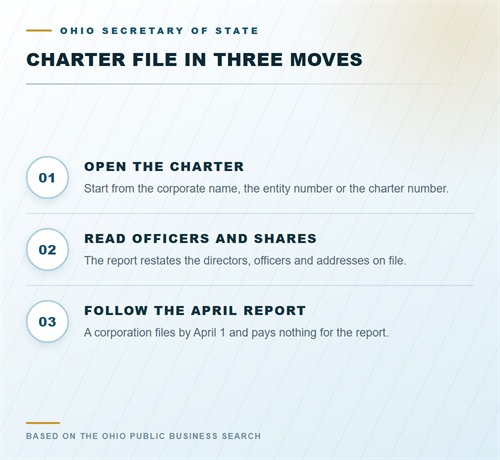
A corporation exists from the moment the Secretary of State accepts its articles of incorporation. At that point the office records an entity number for the register and a charter number for the corporation itself. Either identifier reaches the record, which helps when an older document quotes only one of the two. The charter number rarely appears on modern stationery, but a search still accepts it.
What the Articles State
The articles give the corporate name, the principal office, the statutory agent together with an Ohio street address, the authorized shares, and the incorporators’ signatures. They may also name the initial directors, which saves a separate organizational filing later. Submission runs through the online business filing system, or by mail to 22 N. Fourth St., 16th Floor, Columbus, OH 43215.
Two Numbers, One File
The charter number and the entity number label the same company on the entity record. Paperwork from decades ago often carries the charter number, while a filing made this year leans on the entity number. A search accepts either, and the detail page prints both so a reader can match whichever appears on the document in hand. A mismatch between the two usually means a typo, not a different company.
When the Charter Begins
The charter takes effect on the day the articles are accepted, unless the filing names a later date within the statutory limit. Two companies accepted on the same afternoon can therefore show different start dates. The charter number is assigned when the office acts on the document, not when the incorporator signs it, and the difference can matter in a contract dispute.
Authorized Shares in the Charter
The articles state how many shares the corporation is authorized to issue, and that figure lives in the document image rather than in a summary field. A reader checking the share structure opens the articles themselves. Later amendments can change the number, so the current figure may sit in a more recent filing than the original one.
Domestic and Foreign Corporations
A domestic corporation is chartered in Ohio and keeps its articles, reports, and amendments in one file. A foreign corporation is chartered in another state and registers here through an application that names its home jurisdiction and an Ohio agent. The Ohio record for a foreign company does not include the home charter, so a reader who needs that document must look elsewhere.
The Ohio Charter File
For a domestic company the file begins with the articles and the charter number. Every later document, from the first report to the last amendment, joins the same record under those identifiers. A reader can follow the whole life of the corporation without leaving the page, because the office keeps the sequence of filings intact and in order.
The Registered Foreign Corporation
Registration papers for a foreign corporation list the home state, the date of incorporation there, and the agent in Ohio. The office checks that the name is available and that the agent has accepted the appointment. A foreign company that later leaves files a certificate of withdrawal rather than articles of dissolution, and the record then closes on that document.
What the Foreign Registration Does Not Cover
Ohio reviews the application itself, not the company’s conduct in its home state. The file will not show a home-state license, a home-state judgment, or a merger that took place elsewhere unless the company filed something here. A reader checking a foreign corporation therefore sees only the Ohio side of its existence, which can be a small part of the whole.
Officers, Directors, and Shareholders
Ohio does not publish corporate shareholders on the entity record. The detail page carries no shareholder list, and the annual report does not request one. Directors and officers surface only where a filed document happens to name them, such as initial directors listed in the articles or a representative identified in a merger certificate. A reader who expects a roster will not find one here.
What the Public Record Shows
The record shows the agent, the addresses, the effective date, both identifiers, and the filing history. Corporate governance beyond that stays with the company. A researcher who needs the board or the ownership group must ask the corporation, its agent, or a court, because the Secretary of State’s file will not carry the answer in any form.
Where Officer Names Appear
Some documents name individuals: articles may list initial directors, and a merger certificate can identify the surviving company’s representatives. Those names sit inside the document images rather than in a searchable field. A reader who needs them opens the filing itself and reads the text the corporation submitted to the office at the time. A name search on an officer rarely returns a company unless that person also serves as agent.
Requests for Ownership Details
A lender that needs the ownership group asks the corporation for a schedule of shareholders or an officer’s certificate. The Secretary of State cannot supply that list, and a records request to the office returns only the documents already described on the detail page. Knowing that boundary saves a letter, a fee, and several weeks of waiting for an answer that will not come.
Reaching the Company Directly
The principal office address on the record gives a reader a place to send a written request for information the state does not hold. A letter to the corporation, marked for the secretary or the general counsel, is the usual route. The statutory agent can forward a message but is not obliged to answer questions about ownership or governance.
The Statutory Agent for a Corporation
A corporation appoints a statutory agent to accept service of process and official correspondence. The appointment is not complete until the agent signs a written acceptance that reaches the office with the filing. The appointment needs a physical location in Ohio, so a postal box cannot be used, and that address is printed on the record.
After an Agent Resigns
An agent that leaves the role files notice with the Secretary of State and sends a copy to the corporation. The company then has a short period to appoint a replacement before the record suffers. The incoming agent files an acceptance, and the office updates the detail page once it takes in that change. Until then the record still prints the departing agent’s name.
Address Rules for Agents
The address on the record must be a physical location in Ohio where process can be delivered. A mailbox provider qualifies only when the address is a real street address and the agent accepts service there. The office turns back filings that list a box number in place of a street location, and the rejection costs the applicant time.
Agent Services and Commercial Providers
Many corporations name a commercial service rather than an individual, and the record then shows the service’s name and downtown address. That arrangement keeps the agent steady when officers change. The service receives process and forwards it to the company, but it holds no duty to answer a caller’s questions about the business, its owners, or its finances.
The Annual Report Due April 1
A corporation submits its yearly report by April 1, and the office levies no charge for the submission. The report confirms the principal office, the agent, and a mailing address, keeping the record accurate between charter and dissolution. The state calendar ignores the corporation’s own fiscal year, so a company that closes its books in June still reports in April. A nonprofit corporation follows a different schedule entirely.
Filing the Report
Reports go through the online business filing system, and a confirmation follows acceptance. A company that missed April 1 should file as soon as it can rather than wait for the next cycle, because the history shows the interval between reports. A late report still enters the record in the usual way, with its own document number and date.
Agent Changes and the Report
An agent change does not postpone the annual report. A company that replaces its agent in February can note the new name and address in the April filing, and the office then shows one consistent set of details. Filing the report first and the agent change second works too, though the record carries the older agent until the later filing arrives.
The Nonprofit Calendar
A charitable corporation files on a five-year cycle tied to its formation month and pays a charge each time. The office tracks the cycle apart from the April 1 schedule used by for-profit companies. A nonprofit that also holds an LLC should watch both dates, since the two rarely fall in the same season.
Past Reports in the History
Each accepted report appears in the filing history with a document number and a date. A reader can see whether a company has reported on time over the years or let gaps open between submissions. That pattern matters to a lender reviewing a long relationship with a borrower, and it is visible to anyone who opens the record.
Amendments and Restated Articles
A corporation changes its charter through articles of amendment, which identify the section being altered and set out the new text in full. When the changes are extensive, the company may file restated articles instead, replacing the charter as a whole while keeping the charter number and the original effective date. The office files either document in the same history.
When to Amend
An amendment fits a change of name, a change in authorized shares, a new principal office, or a shift in the stated purpose. Each change should be described precisely, since the office accepts the document as written. Vague wording creates ambiguity that later readers, including lenders and courts, have to work around at their own expense.
Restated Articles
Restated articles gather the charter and every amendment into one current text. They do not create a new corporation; the charter number and formation date stay where they were. The office keeps the earlier documents in the history so the sequence of changes remains visible to anyone reviewing the file from the beginning. A reader comparing versions can see which clauses were carried forward unchanged.
Amending the Corporate Name
A name change runs through the amendment process and carries a fee. The new name must satisfy the naming rules, including a proper corporate ending and enough distance from names already registered. The charter number and entity number stay the same, so a document issued under the old name still points to the same company in a search.
Mergers and Other Combinations
A merger combines two or more corporations, with one surviving and the others ending. The survivor files a certificate of merger naming each party and stating the effective date. The office adds the certificate to the survivor’s file, and the absorbed companies close their records with that document as the final entry in each history.
What a Merger Filing Shows
The certificate identifies the surviving corporation and every company merging into it, along with the plan of merger. A reader can trace which charter continues and which ones end. Filings from the absorbed companies remain available, so their history does not vanish when the merger takes effect and the new structure begins. Those companies keep their own charter numbers in the archive.
Consolidation and Conversion
A consolidation forms a new corporation from two or more existing ones, and the new company receives its own charter. A conversion changes the form of a business, for example from an LLC into a corporation, without dissolving it first. Both filings land in the public record together with the documents that authorized them, and the office records the date each one took effect.
The Survivor’s Identifiers
After a merger the surviving corporation keeps the charter number and entity number it had before. Nothing new is issued for the combined business, which is why a search on an absorbed company returns a record that ends rather than one that continues. A reader following a contract should search the survivor’s name to see the current file.
Dissolution and Withdrawal
A corporation ends its existence by filing a certificate of dissolution after it settles its affairs. A foreign corporation leaves Ohio by filing a certificate of withdrawal instead. Both filings close the record, and both leave the earlier documents available to anyone who needs to check the company’s history at a later date. A reader can tell from the document which path the company took.
The Final Filing
The certificate of dissolution states that debts and obligations have been addressed and that remaining assets have been distributed. The office marks the record dissolved and keeps it online. A reader can still see the charter number, the agent at the time of closing, and every report filed before that date. No further reports are expected from the company.
Revival After Dissolution
Ohio allows a dissolved corporation to be revived, and the office returns the record to active status under the original charter number. The history shows the dissolution date and the revival date side by side. A company in that position should confirm current requirements with the Business Services Division before it sends anything. A revived corporation reports again on the April 1 schedule.
Reading a Closed Record
A closed file still answers most questions a reader brings to it: when the company started, who represented it, and when it stopped. What it cannot show is what happened after the closing date, including later use of the name by an unrelated business. A fresh search on the name is worth running before drawing a conclusion about the present.
Certificates of Good Standing
A certificate of good standing confirms that a corporation exists and has met its filing obligations as of the printed date. Banks, insurers, and licensing agencies request one during due diligence. The office issues it from the same record the public search displays, so the paper and the screen always agree. A reader can check the same facts online before ordering the document.
When a Certificate Is Needed
Lenders ask for one before closing a loan, and out-of-state agencies ask before granting a license. Because the certificate is dated, a copy issued months ago may not satisfy a reviewer who wants current standing. Ordering a fresh document at the time of the transaction avoids that objection and the delay that follows it. A single certificate usually covers one recipient, so a deal with two lenders may need two copies.
Certified Copies of Charter Documents
A certified copy carries a stamp confirming that the reproduction matches the office file. It is the version to send to a court, a bank, or another state’s registration desk. The certificate of good standing and the certified copy answer different questions, and a single transaction may call for both of them. A court may ask specifically for the articles rather than the certificate.
Certificates for Another State’s Registration
A corporation that registers in another state is usually asked for a certificate of good standing from Ohio. The other state’s filing desk wants proof that the company exists at home before it accepts the registration. Ordering the certificate close to the submission date keeps the document current, and a certified copy of the articles may be requested alongside it by the same reviewer.
Ohio Corporation Filing Fees
Each accepted document carries a price, and the schedule below lists the items a corporation meets most often. A faster tier costs extra on top of the standard charge, and the request must accompany the paper. Amounts are revised occasionally, so check the current list before sending payment.
| Item | Amount |
|---|---|
| Charter filing (corporation) | $99 |
| Corporate report | $0 |
| Registered office change | $25 |
| Articles of amendment | $50 |
| Corporate name reservation | $39 |
| Trade name registration | $39 |
| Good standing certificate | $5 |
| Certified copy of a filing | $5 |
| Preclearance opinion | $50 |
| Two-day processing | $100 |
Paying for a Filing
Payment travels with the document whether the filing arrives online or on paper, and a submission without it waits until the office receives the amount. A check should name the Secretary of State, and the filing should carry the entity number so the payment lands on the right record. A receipt is worth keeping beside the company’s own copy of the document.
Frequently Asked Questions
These six questions cover the points readers ask about most when they open a corporate file for the first time. Each answer concerns an entity on the state register, and the figures appear in the schedule above. A specific company’s details come from its own detail page, not from any general statement, so a filing in hand should be checked against the record.
Does Ohio list a corporation’s shareholders?
No. Ownership of shares stays private, and the yearly report never requests it. Ownership information stays with the corporation, which may share it with a lender or a buyer on its own terms.
What is a charter number?
It is the identifier the Secretary of State assigns to a corporation when it accepts the articles of incorporation. The charter number and the entity number reach the same record, so either one works in a search.
When is the corporate annual report due?
April 1, and no fee applies to the report. A nonprofit corporation reports every five years instead, near its formation anniversary, and pays a fee for that filing. A company that misses the date should file as soon as it can.
Can a corporation change its name without a new charter?
Yes. Articles of amendment change the name, and the charter number and entity number stay as they were. A new charter is issued only when a different corporation is formed.
How do I obtain a certificate of good standing?
Order it from the Secretary of State, which draws the certificate from the same record the public search shows. The document is dated, so a fresh copy is best for a closing.
What does canceled mean on a corporate record?
Canceled marks a registration that has been terminated, most often a foreign company that ended its Ohio authority. A domestic corporation that closes by its own filing shows dissolved instead.