

Choosing a name for an Ohio business takes two checks: whether the name is free and whether the law allows it. The Secretary of State compares a proposed name against the names already on the register, then measures it against rules on endings and restricted words. A proposal that fails either test comes back refused, and the filing fee is not the only cost of that outcome.
The sections below follow the naming process from search to registration. They cover the distinguishable-name test, required endings, words that need permission, reservations, trade names, assumed names for out-of-state companies, and the reasons a filing is turned away. Charges for name work appear in a single table near the end, and nothing here replaces the office’s own decision on a particular filing.
Checking a Name on the Register
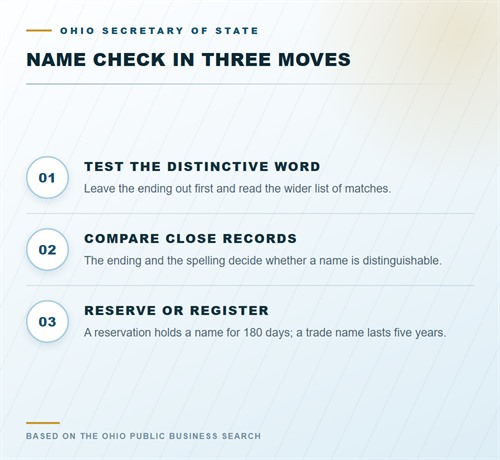
The first check is a search of the business register, where active companies, reserved names, and registered trade names all appear. The Ohio Business Name Search page on this site opens that register. A search that returns no exact match does not guarantee acceptance, because the office measures similarity rather than spelling alone, and a near name can block a filing just as firmly as an identical one.
Ohio Secretary of State, business search for entity names, reserved names, and trade names:
https://businesssearch.ohiosos.gov/
The Distinguishable Name Test
Ohio refuses a name that is not distinguishable from one already on the register. Small differences rarely settle the question: a plural, an ampersand in place of the word and, or a change of punctuation usually leaves two names too close. The office decides each case on the record in front of it, and two applicants can reach different outcomes with names that look equally similar from the outside.
Words That Do Not Separate Names
Articles, conjunctions, and abbreviations carry little weight. A leading the, a trailing period, or the difference between company and co. will not make two otherwise identical names distinct. An applicant who wants a name cleared should change a meaningful word rather than rearrange the small parts around it, because the office reads those parts as noise rather than as identity.
When a Name Is Already Taken
If the register holds a matching name, the applicant has three routes: choose another name, wait for the holder to dissolve or cancel, or obtain the holder’s written consent to use a similar name. The consent route resolves some conflicts without a new name. It requires the holder’s signature, and the office still reviews the result on its own terms before accepting anything.
Similar Names Across Industries
The office compares names with each other, not with the business a company plans to run. Two firms selling entirely different goods can still collide on the register when their names read alike. An applicant who argues that customers would never confuse the two is making an argument the filing process does not weigh, since the test is textual. Only written consent from the earlier holder changes that outcome.
Searching Before You Settle
A search costs nothing and takes a minute. Checking a shortlist of three or four names before drafting anything saves a refusal later, since each rejected submission still consumes time and postage. The search also shows whether a similar name belongs to a company that is active, held, canceled, or dissolved, and that status shapes what the applicant can do next.
Digits and Symbols in a Name
Digits and symbols rarely rescue a name that is otherwise identical to one on the register. A hyphen, a period, or a numeral at the end of a word does not give the office a reason to treat two names as separate. Change a word that carries meaning, and the proposal stands a better chance of acceptance.
Required Endings and Restricted Words
An LLC name must include a recognized ending such as limited liability company, LLC, or ltd. liab. co. A corporation uses incorporated, corporation, company, or an abbreviation of one. The ending is not decoration; a filing that omits it comes back refused even when every other part of the name is sound. The office matches the ending to the filing type before it reads anything else.
Endings by Entity Type
The ending has to match the entity being formed. An LLC cannot close with corporation, and a corporation cannot close with LLC. Professional associations, nonprofit corporations, and cooperatives each carry their own acceptable endings, and a limited partnership differs again. A filer who copies an ending from another company’s name often copies the wrong one for the form at hand.
Words That Need Permission
Some words suggest a regulated activity, and the office will not accept them without proof of authority. Bank, trust, insurance, and similar terms usually call for a letter from the state agency that supervises the business. A name built around one of those words should be cleared with that agency before the formation papers are drafted, since the letter travels with them.
Names That Suggest a Profession
A name that implies a licensed occupation can draw a second review. Words tied to engineering, accounting, or medicine may require evidence that the owners hold the license the name suggests. The office reads the name as the public will read it, not as the applicant intended it, and a refusal on that ground is difficult to argue after the fact.
Searching by Name, Number, or Trade Name
The register answers three kinds of question: what a name returns, what a number returns, and what a trade name returns. A name search is the usual starting point for a new business, while a number search suits someone holding a document from an older transaction. All three routes end at the same detail page, so the extra fields change only the route and not the destination.
What the Register Holds
The register holds active companies, foreign registrations, reserved names, and registered trade names. It also keeps records of companies that have dissolved or been canceled, which is why an old name can still return a row. A reader should check the status before assuming a name is free, because a closed record does not always release its name at once.
Reading a Result Row
A result row shows the name, the entity or registration number, the type, and the status. Opening the row adds the addresses, the agent, and the filing history. The type matters when two rows carry similar names, since a trade name and a legal entity name are not the same thing and are governed by different filings and different fees.
Saving What a Search Returns
A search result is a moment in time, and the register keeps moving. An applicant who finds a clear name in March may find it reserved by someone else in May. Printing the result or noting the date beside the name gives a business a record of what it saw, which is useful when the formation papers are drafted weeks later. A note without a date is worth little in that setting.
Reserving a Name for 180 Days
A reservation holds a name for 180 days while the applicant prepares the formation filing. The office charges a fee and records the reservation against the applicant’s name. During that window the reserved name is protected from new registrations by others, though the reservation does not create a company, authorize business activity, or excuse the later formation filing in any way.
Who Applies for a Reservation
An applicant can reserve a name before forming the entity, and an existing company can reserve one it intends to adopt later. The form asks for the applicant’s name and address and requires a signature. Once accepted, the reservation appears on the register beside active companies, where a later searcher will see it and know that the name is spoken for.
Reservations Before a Name Change
A company that plans a merger or a later name change can reserve the intended name before the paperwork is ready. The reservation keeps the name off the market while the board approves the transaction. It does not bind the office to approve the amendment later, since the same tests apply when that filing finally arrives. Timing the reservation to the closing date avoids paying for days the company cannot use.
Telling a Reservation from a Registration
A reservation and a registration look similar in a search result but carry different weight. The reservation holds a name for a limited period without forming a business, while a registration creates the entity or the trade name itself. A reader who mistakes one for the other may think a company exists where only a place has been held.
After the Reservation Expires
When the 180 days run out, the name returns to the pool and anyone may claim it. A company that still wants the name should file its articles of organization or a fresh reservation before the period closes. The office does not hold a lapsed name for the original applicant, and no reminder is sent as the date approaches.
Trade Name Registration
A trade name is the name a business uses in its dealings when that name differs from its legal name. Registering one puts it on the public trade name record for five years and gives the holder priority against later registrations of the same name. The filing is separate from the entity’s formation documents, and a company can hold several trade names at once.
When a Trade Name Helps
A company that runs a division under a second name, or a proprietor who trades under a brand, registers the trade name so customers and lenders can trace the business behind it. The registration ties the trade name to the owner’s legal name and address on the public file. Advertising under a name that was never registered leaves that link to guesswork.
Searching a Proposed Trade Name
A trade name should be searched before it is registered, because the office applies the same distinguishable test it uses for entity names. A proposed trade name that matches an existing company can be refused, and the fee that travelled with the filing does not resolve the conflict. Running the search first keeps the application clean.
Names for a Sole Proprietor
A sole proprietor has no formation filing, so there is no legal entity name on the register. The name the business uses is a trade name, and the office registers it so customers can connect the brand to the individual behind it. Without that entry, the public record shows nothing about the name, and the link rests on whatever paperwork the owner keeps privately.
Changing or Ending a Trade Name
A registered trade name can be changed through a name-change filing, and it can be canceled when the business stops using it. Both filings carry a fee and both appear in the register. A registration that is not renewed after five years lapses on its own, and the name then becomes available to another applicant at any time.
Trade Name Versus Legal Name
The two names serve different purposes. A legal name identifies the entity that signs contracts and files reports, while a trade name identifies how the business presents itself to customers. Confusing them leads applicants to register the wrong one, and a company that advertises a trade name without registering it has no public record to point to when a dispute arises.
Amendments and Name Changes
Changing the legal name takes an amendment filing, and the office collects a charge for it. The new name must pass the same checks as the original: a proper ending, a distinguishable form, and no restricted word without permission. The entity number stays with the company through the change, so old and new documents meet in one file.
Timing a Name Change
A name change takes effect when the office accepts the amendment, so stationery, signs, and bank records should follow that date rather than the day the board voted. Customers who search the old name still find the record, because the history keeps the earlier documents and the prior name stays visible inside them. Nothing about the change hides the older identity.
Names Held by Another Company
If the wanted name belongs to a company that has dissolved, the register may still show it until the office processes a change. A search result should be read with its status rather than its name alone. A dissolved holder usually clears the way, but the office makes that decision when the filing arrives, not in advance of it.
Names for Out-of-State Companies
A company formed in another state that registers in Ohio must use a name that is available here. If its home name is taken, it adopts an assumed name for Ohio use and files that with the registration. The assumed name appears on the Ohio record beside the home name, and the public search returns the company under either one of them.
Choosing an Assumed Name
The assumed name follows the same rules as any other: an ending that fits the entity type and enough distance from names already registered. An applicant should search the proposed assumed name before submitting, because a refusal delays the whole registration. The office records the assumed name as part of the same filing, not as a separate company with its own number.
Registering the Assumed Name
The assumed name is filed with the registration application, and one fee covers the submission. Once accepted, the record shows both names, and the Ohio filing history carries the date for each. A later change to the assumed name runs through an amendment rather than a new registration, which keeps the foreign company’s Ohio history in one place.
Withdrawal and the Assumed Name
When a foreign company withdraws from Ohio, its registration ends and the assumed name goes with it. The record keeps the history, but the name returns to the pool unless someone else already holds it. A company that intends to come back should reserve the name or file a fresh registration rather than assume the old entry still protects it.
Why a Name Filing Is Refused
Refusals come from a short list of causes: a missing ending, a name too close to one on the register, a restricted word without consent, or an incomplete form. The office returns the filing with a notice, and the applicant can correct the defect and submit again. A corrected filing is reviewed as a new submission, so the queue starts over when it arrives.
Reading a Refusal Notice
The notice points to the section that failed and often names the conflicting record. An applicant can search that name and see why the office drew the comparison. Correcting the specific problem is faster than submitting a different name and hoping the second attempt passes, since a fresh name raises its own questions about endings and similarity.
Avoiding the Same Refusal Twice
Before resubmitting, check the ending against the entity type, search the revised name, and confirm that no restricted word remains. A preclearance review from the office can catch defects before the formal filing, which suits applicants who have already been refused once. The review carries a fee, and it is separate from the filing it examines.
Names and Status on the Register
A name search returns a status, and the status tells the reader how much the name matters. Active means a company is using the name right now. Held marks a record the office is holding, Canceled marks a registration that has ended, and Dissolved marks a company that filed to close. A reserved name shows as a reservation rather than a company.
Names That Return No Result
An empty result is useful but not conclusive. The register covers Ohio filings, so a business operating under an unregistered trade name will not appear, and a federal trademark search sits outside this system. A name that returns nothing is a candidate, not a guarantee, and the office still tests it when the filing arrives with its fee.
Names Reserved by Another Applicant
A name can show on the register as reserved even though no company exists under it. That entry blocks a new formation filing just as an active company would. An applicant who sees a reservation should note the date it ends, because the name may open within months, and a later search will show whether it did.
Watching a Name Over Time
Names change hands. A company that dissolves releases its name, and a reservation that lapses frees one that was spoken for months earlier. An applicant who is not ready to file can search again later rather than rely on a result from last year. The register is current, and a fresh search costs nothing but a few keystrokes.
Name-Related Filing Fees
The office charges for each name service it performs, and the table below gathers the ones that arise while a business is choosing, holding, or registering a name. Expedited handling adds a separate amount on top, and the request has to travel with the document. Amounts change from time to time, so confirm the current schedule before paying.
| Item | Amount |
|---|---|
| Reserved name, 180 days | $39 |
| Trade name registration | $39 |
| Trade name name change | $25 |
| Legal name change | $50 |
| LLC formation | $99 |
| Corporation formation | $99 |
Frequently Asked Questions
Six questions come up regularly from applicants who are choosing a name and want to know what the office will accept. Each answer concerns a submission to the Secretary of State, and the prices appear in the schedule above. A name that matters to a contract or a loan deserves a fresh search on the day of the filing, not a note from an earlier attempt.
How do I check whether a name is available in Ohio?
Search the Secretary of State’s business register at businesssearch.ohiosos.gov. Enter the proposed name and read the results by status, not by name alone. A clear result is a signal, not a guarantee.
How long does a name reservation last?
A reservation holds a name for 180 days from the date the office accepts it. The reservation keeps other applicants from registering the same name during that window, and it ends automatically when the period closes.
What ending does an Ohio LLC name need?
The name must close with limited liability company, LLC, or another recognized abbreviation. A name without a proper ending is refused even when the rest of the wording is acceptable.
Can two Ohio companies have similar names?
Only when the office finds them distinguishable or when the earlier holder gives written consent. A plural, a punctuation change, or a swapped abbreviation usually leaves the two names too close to approve.
Is a trade name the same as a legal name?
No. The legal name identifies the registered entity, and a trade name covers a sign or brand registered on its own five-year cycle. The two filings are separate.
Why was my name filing refused?
The notice usually points to a missing ending, a restricted word, or a conflict with a name already on the register. Correct that item and submit again, or ask for a preclearance review before resubmitting.