

A trade name is the name a business presents to the public when that name differs from the legal name on its formation documents. Ohio records these registrations through the Secretary of State, and the resulting entry sits on the public file next to the underlying company. Customers, suppliers, and banks often know a business only by the name on the sign, which makes the registration the link between that sign and the entity behind it.
What follows sets out who files a trade name, how long a registration lasts, which changes require a new document, and how a registered name surfaces in a search of the state file. Fee amounts are grouped in one table near the end.
What a Trade Name Registration Does
Registering a trade name places the name on the public record and ties it to a registered business. It does not create a separate company, does not shield anyone from liability, and does not grant exclusive rights to the name. An Ohio DBA Search reaches the entry, and from there the company that filed it.
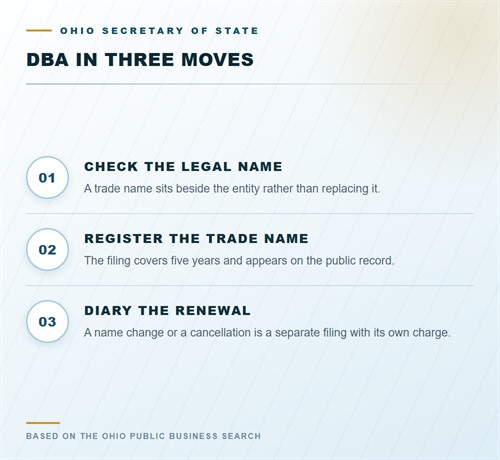
Trade name forms and business filing information:
https://www.ohiosos.gov/businesses/
Who Files a Trade Name
Any business operating under a name other than its legal name files one, whether the underlying entity is a limited liability company, a corporation, a partnership, or a sole proprietorship. A company that trades under several names files for each of them. The registration identifies the entity responsible for the name and leaves no doubt about which company stands behind a storefront.
Businesses That File Most Often
Retail shops, restaurants, contractors, and service firms file most frequently, since they usually trade under a label rather than their registered corporate name. A holding company that owns several locations may hold a separate registration for each location’s name while operating under one legal entity. Franchise operators file in much the same way.
What the Filing Requires
The form calls for the trade name, the legal name of the entity filing it, the entity’s registration number, and a signature from an authorized representative. A filing that omits the entity number is returned. The office records the filing date, and that date starts the five-year term.
Sole Proprietors and Trade Names
A sole proprietor with no registered entity can still file a trade name, though the filing identifies the individual rather than a company. Many such businesses register after a bank or a landlord asks for documentation of the name. Forming an LLC later means updating the registration so the entity, not the person, holds it.
Registration After Forming the Entity
A newly formed company can register a trade name the same week its articles are accepted, once the entity number exists. Filing before formation is not possible, because the form asks for a number the office has not yet assigned. The order is formation first, trade name second, with the entity number carried across.
Franchise and Licensed Names
A franchisee usually trades under a name owned by the franchisor, and the local filing records which entity uses it. The franchisor’s own registration is separate. When the agreement ends, the local registration should be canceled so the name no longer points at a former operator. Leaving it in place misleads anyone checking the business behind the sign.
Trade Name Versus Legal Name
The legal name is what appears on the articles of organization or articles of incorporation and on the entity record. The trade name is what the business puts in front of customers. A company registered as Northgate Supply Holdings LLC might trade as Northgate Hardware. The two names coexist, and only the legal name identifies the entity on formal documents.
Where Each Name Belongs
Contracts, tax filings, and loan documents generally use the legal name, often with the trade name noted alongside. Signage, advertising, invoices, and a storefront use the trade name. Mixing them on a legal document can create confusion about which business is bound, so the distinction is worth keeping straight on every form.
When a Business Has Two Names
A company may register more than one trade name and use each for a different line of work. Each name carries its own registration, its own term, and its own expiration date. One name lapsing does not affect the others, and the entity record remains identical behind all of them.
Difference From a Name Reservation
A name reservation holds a name for an entity that has not yet been formed, and it lasts 180 days. A trade name registration is filed by a business that already exists and covers a name it uses now. The two documents serve different purposes, and a reservation does not function as a trade name filing.
Naming a Division or Product Line
A division name or a product line can serve as a trade name when it appears on invoices, signage, or advertising. A company that markets a single product under its own label registers that label if customers treat it as the business name. Internal department names need no filing at all.
The Five-Year Term
A trade name registration runs for five years from the filing date. The term is fixed and does not depend on the entity’s own standing, though a trade name held by a dissolved company has little practical value. The expiration date appears on the record, and the registration does not renew itself at any point during that term.
What Happens at Expiration
When the term ends without a renewal, the name drops off the active record. The entity itself is unaffected. The consequence falls on anyone trying to connect the public name to the company, since the linkage is no longer documented until a new registration is filed and accepted.
Why the Term Is Fixed
The five-year cycle forces a periodic check that the name is still in use and still belongs to a live business. A registration that outlived the business would mislead anyone who found it. The fixed term keeps the public list closer to reality than an indefinite filing would.
Tracking Expiration Dates
The expiration date is easy to lose once the filing is complete and the name is in use. A reminder set a few months before the fifth anniversary covers most of the risk. Companies holding several names should keep one list with every date on it rather than rely on memory across the years.
Term When Ownership Changes
Selling a business does not move the trade name registration to the buyer on its own. The new owner either files a change or cancels the old entry and registers the name again. Leaving the previous owner’s entity attached to the name misleads anyone who checks the record afterward.
Renewal Before Expiration
Renewal is a fresh registration filed before the term ends. Filing early avoids a lapse, and a lapse removes the name from the record as belonging to that business. Searching during the gap shows no active entry, which can complicate a lease, a loan application, or a payment account review at the worst possible time.
Timing a Renewal
A registration approaching its fifth year should be renewed with enough lead time to absorb processing delays. A renewal filed after the expiration date is treated as a new registration, and the continuous history that a timely filing preserves is lost in the process.
Renewal and Records From the First Term
A renewal starts a new five-year period, and the earlier entry stays in the record with its original dates. The history shows continuity rather than one undated registration, which helps when a landlord or a bank asks how long the name has been in use. The older dates also survive a later change filing.
Renewal After a Name Change
A registration amended during its term renews under the changed name, and the new filing should carry that version. Filing a renewal under the retired name restarts a conflict that the change was meant to resolve. Checking the current entry before renewing takes a minute and prevents a returned submission.
Changing a Registered Trade Name
When a business adopts a different trade name, it files a name change for the registration rather than starting over. The change updates the entry while preserving the history of the original filing. A business adding a second name files a separate registration instead of amending the first one.
What the Change Filing Carries
The change identifies the current registered name and its replacement. It is a shorter document than the original registration and is filed by the same entity. Once accepted, the entry shows the changed name with the date of that filing, while the original registration stays in the history.
Keeping the Entity Link Current
The entry points to an entity by name and number. If that entity later changes its legal name, the trade name entry may still show the earlier version. A change filing keeps the two consistent, though the mismatch does not invalidate the trade name itself or shorten its term.
Canceling a Registration
A cancellation ends a registration before its term expires. Businesses cancel when they stop using a name, sell the operation, or fold several names into one. Cancellation is a separate filing with its own charge. Leaving an unused name registered keeps it attached to a business that no longer uses it, which can look careless to a lender.
Records After Cancellation
The cancellation does not erase the earlier filing. The record shows the registration and the cancellation, with dates for both. A reader can see that the name was once in use and that it was retired, which is often what a vendor or a landlord is trying to establish about a sign that has come down.
Cancellation When the Entity Closes
Closing a company does not automatically cancel its trade names, and a dissolved entity can leave a live registration behind. Filing the cancellation closes that loose end and keeps the record from suggesting an active business. Reviewing trade names belongs on the same checklist as the final annual report.
Canceling One of Several Names
A business with three registered names can retire one without touching the other two. The cancellation identifies only the name being dropped. Each remaining registration keeps its own term and expiration date, and none of them is affected by the filing that removed the third.
Cancellation and Outstanding Contracts
A cancellation does not end contracts or obligations tied to the name. Invoices, leases, and supply agreements continue on whatever terms they carry. The filing changes the public record only, so a business should retire the name from active paperwork and signage at the same time it files.
How a DBA Appears in Search
A registered trade name appears as its own entry in the public search, with a reference to the entity that filed it. Searching the trade name returns the entry and, through it, the legal company. A search of Ohio business names by the trade name is often the fastest route from a storefront sign to a registered entity.
Searching the Trade Name Alone
Entering the trade name in the name field usually returns the trade name entry and any entity whose legal name resembles it. The two are distinct records. Opening the trade name entry shows the entity number that connects them, and that number leads to the full file with its agent and status.
Names That Are Not Registered
A business using an unregistered name will not appear under that name at all. A search returns nothing, which is not evidence that the business is unregistered, only that the name is. That accounts for many storefronts that cannot be matched to an Ohio record on the first attempt.
Searching by Entity Number Instead
When the company is already known, its entity number reaches the record faster than a name search. The trade names attached to it sit in the same file, though not always as separate rows in the results. Reading the entity record is often enough to confirm which names belong to it.
What the Trade Name Record Shows
The entry lists the trade name, the filing date, the expiration date, the entity that registered it, and the entity’s registration number. It does not list owners, officers, or the locations where the name is used. A trade name record is thinner than the entity record it points to, and the entity record is where the agent and principal office appear.
Where to Continue a Search
From the trade name entry, the next move is usually the entity record itself, which carries status, address, and filing history. A trade name with a dissolved entity behind it is a warning worth noticing before a contract or a deposit is arranged with the business.
Requesting a Copy of the Registration
A copy of an accepted trade name filing can be ordered from the office. Banks and landlords sometimes ask for documentation beyond a screen capture, and a certified copy carries the seal that makes it usable as evidence. The charge for a certified copy appears in the table below.
Names Recorded Under a Parent Entity
A parent company may register trade names on behalf of subsidiaries or holding entities, and the entry shows whichever company filed it. That company, not the location, is the one answerable for the name. Reading the entity line before the name line keeps a researcher from crediting the wrong business.
Trade Names and the Annual Report
The annual report confirms the agent and the principal office, and it does not list trade names. A business that adds or retires a name outside the report cycle still needs the separate filing. The two records are read by different people, so neither one updates the other automatically.
Trade Names Across State Lines
Ohio’s registration covers use within the state. A business operating elsewhere may face assumed-name or fictitious-name requirements in each of those states, and compliance in Ohio does not satisfy another jurisdiction. Each state keeps its own filing, its own term, and its own charge for the work.
When a Second State Is Needed
A company that opens a location in another state usually registers the name there as well, often alongside a foreign entity registration. The two filings are separate, and a trade name registered only in Ohio does not put the name on file in a state where the business has no registration at all.
Trademark Protection Sits Apart
State registration does not create trademark rights. Federal registration through the Patent and Trademark Office is a separate process with its own examination and its own charges. A business that intends to build value in a name should treat the Ohio filing as a disclosure rather than as protection against a competitor.
Which State’s Record to Search First
A business with locations in several states usually registers where it was formed and then wherever it operates. Starting with the formation state gives the entity history, and each additional state supplies its own registration details. Searching only the state where a customer stands can miss the company that actually owns the name.
Fees for Trade Name Work
The charges below apply to trade name filings and to the documents most often submitted alongside them. A change and a cancellation are separate transactions, each billed on its own and neither credited against the other.
| Item | Amount |
|---|---|
| Trade name, five years | $39 |
| Name change on a trade name | $25 |
| Trade name cancellation | $25 |
| Reserved name, 180 days | $39 |
Frequently Asked Questions
These are the points filers raise when registering, changing, or canceling a trade name in Ohio for the first time.
Does a trade name create a separate business?
No. The trade name is a label attached to an existing registered business. Liability, taxes, and contracts stay with the entity that filed the registration, and the name adds no separate legal existence.
How long does an Ohio trade name last?
Five years from the filing date. The registration does not renew automatically, so a new filing is needed to keep the name on the record past the term. The expiration date is shown on the public entry.
Can two businesses register the same trade name?
The office records the filing rather than granting ownership of the name. A business worried about confusion should look at trademark protection separately from this registration, since the two systems answer different questions.
Is a trade name the same as a name reservation?
No. A reservation protects a name for 180 days before formation. A trade name filing comes later, once the business is operating under a sign that differs from its legal name.
What filing ends a trade name early?
A cancellation. It terminates the registration before the five-year term expires and is charged separately from the original filing. Businesses cancel when a name is retired or the operation is sold.
Where does a trade name show up in search?
As its own entry linked to the underlying entity. Searching the trade name returns the registration and the company behind it, which is how a customer or vendor identifies the legal business behind a storefront.
Before Filing a Trade Name
Two checks come first. Confirm that the underlying entity is Active, since a registration attached to a company in Held or Dissolved status creates a confusing record. Then search the proposed name to see what already exists. Reviewing Ohio business records alongside the trade name search shows whether another company already uses the name in a related line of work.