

Ohio company search opens the register that the Secretary of State’s Business Services Division keeps for every entity formed or registered in the state. The lookup runs on the public business search, the same office that accepts filings, and it reads the current database rather than a periodic extract. A query returns the legal name, the entity or charter number, the entity type, the status, the statutory agent, and the documents the office has accepted.
This page covers the search routes, the classes the register holds, the fields on an entity page, the meaning of each status value, the annual report that keeps a file current, and the certificates a reader can order. It serves a buyer checking a supplier, a landlord screening a tenant, a founder confirming a filing, and a lender who needs a dated document before releasing funds.
How an Ohio Company Search Runs
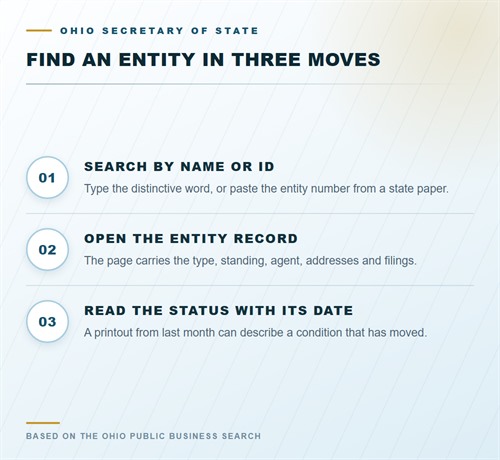
The public business search opens on a single query box that accepts a name or an entity number, and no account is needed for that move. A visitor types the distinctive part of the name and receives a list of matching records. The screen reads the live register, so a name changed last month appears under the new spelling rather than the old one. The search covers every class in one index, so a query can return a limited liability company, a business corporation, a nonprofit, and a foreign registration that share a word. The entity type beside each result separates them, and the status tells a reader whether the file still stands.
Searching by Name
Type the distinctive word and leave the ending out on the first attempt. A full legal name with punctuation can return fewer hits than a short fragment, because the index stores the name exactly as it was filed. Where the first attempt comes back thin, try a second spelling and check the statutory agent field as a second route into the same file.
Searching by Entity Number
The entity number is assigned when the formation document is accepted and it stays with the file for as long as the record exists. A corporation also carries a charter number, and either reference reaches the same entry. A reader holding a certificate, an annual report notice, or an old receipt can paste the number and skip the name list entirely.
Reading the Result List
A row gives the name, the entity number, the type, the county, and the status. A long list usually means the query word was broad, not that the company owns affiliates. Narrow by type and status, then open the entry whose address matches the business in front of you. Note the entity number beside each close match, because the note keeps two similar companies apart in a later summary.
What the Search Returns
A name query returns a table rather than a report, and each line carries the entity number so a reader can open the right file without guessing. The columns list the legal name, the type, the county of record, and the current status. From that table the record view adds the agent, the addresses, and the filing list, which is the part a counterparty usually needs.
Ohio Secretary of State public business search:
https://businesssearch.ohiosos.gov/
What the Ohio Register Holds
The register is a filing system built around formation documents. It records the creation of an entity, the amendments that change it, the reports that keep it current, and the papers that end it. Each entry carries the legal name, the type, the entity number, and the dates attached to the documents the office accepted. It also carries the statutory agent, the principal office, and the mailing address the entity declared. What it does not carry is a licence, a tax account, or a court file, because those records sit with the agency that issues them.
Entity Classes in the Index
Ohio files limited liability companies, business corporations, nonprofit corporations, limited partnerships, limited liability partnerships, and foreign registrations in the same system. Each class follows its own chapter of the Revised Code and files its own set of documents. The type field matters because the reports, the charges, and the internal governance differ by class.
Foreign Entities
A company formed in another state registers here before it transacts business in Ohio. The registration records the home jurisdiction, the home name, the local agent, and the office the company will use. A foreign registration can be amended, cancelled, or withdrawn, and each action leaves a dated entry on the file.
What the Register Leaves Out
The file does not name the members of a limited liability company, and it does not list the shareholders of a corporation. It does not show revenue, employees, customers, or litigation. A member list and an operating agreement stay with the company rather than with the state, and a tax account sits with the Department of Taxation.
Trade Names and Fictitious Names
A trade name or fictitious name registration appears as its own filing, tied to the owner rather than to a new entity. The record shows the registered name, the owner, and the expiry date, and it does not create limited liability. A reader who finds a storefront name should look for the legal entity behind it before treating the name as a company.
The Fields on an Entity Record
An entity page is short, but each block answers a separate question. The name block identifies the filer, the status block says whether the registration still stands, the address blocks say where notices go, and the document list says what has been filed. Read the blocks in that order, then compare the dates. A recent amendment can change an address that an older paper still shows, and a record printed last month may describe a condition that has already moved. The date beside each entry is what makes the page useful, because it separates a current fact from a historical one.
Legal Name and Entity Type
The legal name is the string on the formation document, not the name on a sign or a website. Ohio requires a limited liability company to carry Limited Liability Company, L.L.C., or LLC, and a corporation to carry Corporation, Incorporated, Company, Corp., Inc., or Co. A trade name filed by the same owner can sit beside the legal name, which is why the type field travels with every note.
Statutory Agent and Office
An Ohio street address is where a summons may be delivered, and a named party is who receives it. The two belong to one appointment, and neither may be a post office box. A commercial agent appears on many records, while a noncommercial agent is often an owner or a lawyer. The registered office and the principal place of business are separate fields and often differ.
Document List and Dates
The list runs through the life of the file: formation, amendments, reports, agent changes, mergers, and closure, in the order the office processed them. Each line carries a paper type and a posting date. A gap followed by a report describes a company that came back, not one that never slipped.
County and Address Fields
Ohio records the county where the principal office sits, and that field helps separate two companies with a similar name. The mailing address and the statutory office can sit in different counties, which is normal for a business that keeps its paperwork with an agent. Compare the county with the address on the invoice before drawing a conclusion.
What the Status Values Mean
Ohio publishes a small set of status words, and each one changes what a counterparty should do next. The word sits beside every result, so a list can be screened before any file is opened. A status value reports compliance rather than quality, and two active companies can differ in age and credit strength. The same word appears on a certificate of good standing, which is why a lender asks for that paper rather than a screenshot. A record that shows an inactive status may still describe a business that trades, but the state file no longer supports a claim that the company is compliant.
Active and Held
An active entity holds a registration in force and has met the filing duties that apply to its class. A held status marks a file that the office has paused, often because a report or a payment did not arrive. The date of the last accepted document is the field that accounts for the label.
Canceled and Dissolved
A canceled registration usually belongs to a foreign entity that withdrew, while a dissolved one belongs to a domestic company that closed or lapsed. The record then shows the closure with a date, and contracts signed afterward become awkward to enforce. A closure posted by the office is not the same as a voluntary dissolution filed by the owners.
Reinstated and Merged
A restored company is live once more, and the entry carries the closure and the return as separate dates. A merged company no longer stands alone, because its assets and duties passed to a survivor. Both records stay useful, since they show the chain, and a contract signed before a merger binds the surviving entity.
The Statutory Agent on the Record
The agent is the party that accepts legal papers for the company, and the appointment is part of the formation filing rather than a separate registration. Ohio requires a written appointment and acceptance, and the office keeps that paper with the file. A company that changes agent or address files an update and pays a modest charge. An agent may be an Ohio resident or a business entity authorized to operate in the state, and the address must be a physical location where documents can be handed over. A postal box fails the test, and a mailbox service that cannot sign for deliveries fails it too.
Commercial and Noncommercial Agents
A commercial agent holds many appointments and keeps a staffed office, which makes a change of address simple to track. A noncommercial agent is often an owner, an officer, or a lawyer, and the appointment costs nothing beyond the filing itself. The trade is convenience against continuity, because an owner who moves must update the record.
Service of Process
A lawsuit against a company starts with delivery to the agent at the statutory office. When the agent cannot be found, the statutes allow an alternative route through the Secretary of State, and the record then shows the paper that was left. A reader checking a supplier should treat a stale agent address as a warning that notices may not reach anyone.
Filings That Keep a File Current
An annual report keeps an Ohio entity on the active list, and the report is due by April 1 for a limited liability company and a corporation. The report confirms the agent, the office, the mailing address, and the officers or members the form requests. The duties differ by class, and the register shows which papers were actually accepted. A company that changes its name, its office, or its agent files the statement that matches the change. A company that closes files articles of dissolution, and a company that merges files the merger papers. Each action carries its own charge, and each one leaves a dated line on the file.
Annual Reports
The annual report is filed through the Secretary of State’s online system, and the portal keeps the confirmation in the account. A nonprofit follows a different schedule and a smaller charge. The report is not a financial statement, and it does not ask for revenue or profit, only the facts the office needs to keep the record accurate.
Amendments and Changes
An amendment alters the terms of the formation document, such as the name or the management structure. A statutory agent update moves the appointment without touching the rest of the charter. A correction fixes a clerical error in a paper already accepted, and the office keeps the original beside the correction.
Reinstatement After Lapse
A company that lost its registration can file for reinstatement, and the record then carries the closure and the return as separate dates. The gap remains visible, so a lender can see how long the entity sat inactive. Reinstatement does not erase old filings, and the agent and office must be current before the application is accepted.
Certificates and Copies
A certificate turns a search result into evidence another party will accept. Banks, landlords, and out-of-state registries usually want a dated certificate rather than a printout, because the document carries the office seal and states the standing on a specific day. A certified copy serves a different purpose, because it reproduces a filed document with the state’s certification attached. Ohio prices a certificate of good standing and a certified copy as separate products, and a multi-page document can carry more than one copy charge. A plain download from the search portal is free but unsealed. A reader who needs the exact wording for a contract orders the certified version.
Certificates of Good Standing
The certificate states that the entity exists and reports its standing on the day of issue. It does not list owners and does not certify that the business is licensed or profitable. A foreign registry may also want an apostille, which the Secretary of State issues for a separate charge.
Certified and Plain Copies
A certified copy repeats a paper already on file, such as the articles or an amendment. A plain copy carries the same text without the seal. The request names the document and its filing date, and the office prices the order by type, so a reader should ask before assuming the total.
Apostille for Out-of-State Use
A document that will be used outside the United States may need an apostille, which the Secretary of State issues after the paper is certified. The apostille authenticates the signature and seal rather than the content. A reader ordering one should confirm the destination country accepts an apostille rather than a consular legalisation.
Fees for Searches and Filings
The lookup itself costs nothing, and the amounts below cover the papers a reader is most likely to order or send. Ohio sets these charges in statute, so the figures stay the same until the legislature changes them. A formation filing, an agent update, and a certificate each carry their own line.
| Ohio item | LLC | Corporation |
|---|---|---|
| Business search | $0 | $0 |
| Formation filing | $99 | $99 |
| Name reservation | $39 | $39 |
| Trade name registration | $39 | $39 |
| Statutory agent update | $25 | $25 |
| Legal name change | $50 | $50 |
| Annual report | $0 | $0 |
| Good standing certificate | $5 | $5 |
| Certified copy, per document | $5 | $5 |
| Preclearance review | $50 | $50 |
| Two-day expedited filing | $100 | $100 |
Checking a Supplier or Tenant
A check before a payment starts with the register and then moves outward. Confirm that the name on the contract matches the legal name, that the status is active, and that the address on the invoice matches the statutory agent or the office. A mismatch is not proof of fraud, but it is a reason to ask for a paper that ties the trading name to the entity. Keep the printout with the date, because a status can move between the check and the signature. A reader who repeats the lookup on the day of signing catches a change that arrived overnight, and a dated certificate settles the question when a counterparty asks what the office certified.
Expedited and Preclearance Charges
The office offers faster handling for an added charge, and the amount rises as the window shortens. A preclearance review is a separate service that checks a draft before it is filed, which helps where a name or a clause is uncertain. Both are optional, and neither changes the underlying filing charge shown in the table.
Frequently Asked Questions
The questions below come from readers checking a supplier, a tenant, or their own filing. Each answer names the field or the office that decides the point.
Is the Ohio company search free?
Yes. The public business search opens without an account and charges nothing for a lookup. Money is owed only when a filing is sent or a document is ordered, and the search can be repeated as often as a review requires.
Where do I find the entity number?
It is printed on the formation certificate, on the annual report notice, and on a certificate of good standing. A corporation also receives a charter number. Take the reference from a state document rather than a directory, because a copied digit sends the search to the wrong file.
When is the annual report due?
April 1 each year for a limited liability company and a corporation. A nonprofit follows its own schedule and charge. A report received after the deadline carries a penalty, and a long silence can end the registration.
What does a certificate of good standing show?
It is the office’s dated statement that an entity exists and holds a given status. It does not list owners, and it does not certify a licence or a tax account.
Can I search by owner name?
The register accepts a person name, but the match usually reflects the statutory agent field. Owners are not listed on the public page.
Does the record show tax debts or liens?
No. The business register reports filings and standing only. Tax balances sit with the Department of Taxation, and liens sit with the county recorder or the court that issued them.